

Hydraulic vs. Non-Hydraulic Skid Steer Attachments: What’s the Difference?
Attachments are what turn a skid steer from a single machine into a whole fleet of tools, but not all of them work the same way. Some rely on the machine’s hydraulic system to power moving parts, while others simply use the machine’s motion and lifting force to get the job done. Knowing the difference matters more than you might think, because choosing the wrong type can leave you with an attachment your machine cannot run or capability you paid for and never use. This guide breaks down how each type works, the jobs they suit, how they perform, what they cost to own, and how to choose the right one for your skid steer and your work.
Understanding Hydraulic and Non-Hydraulic Attachments
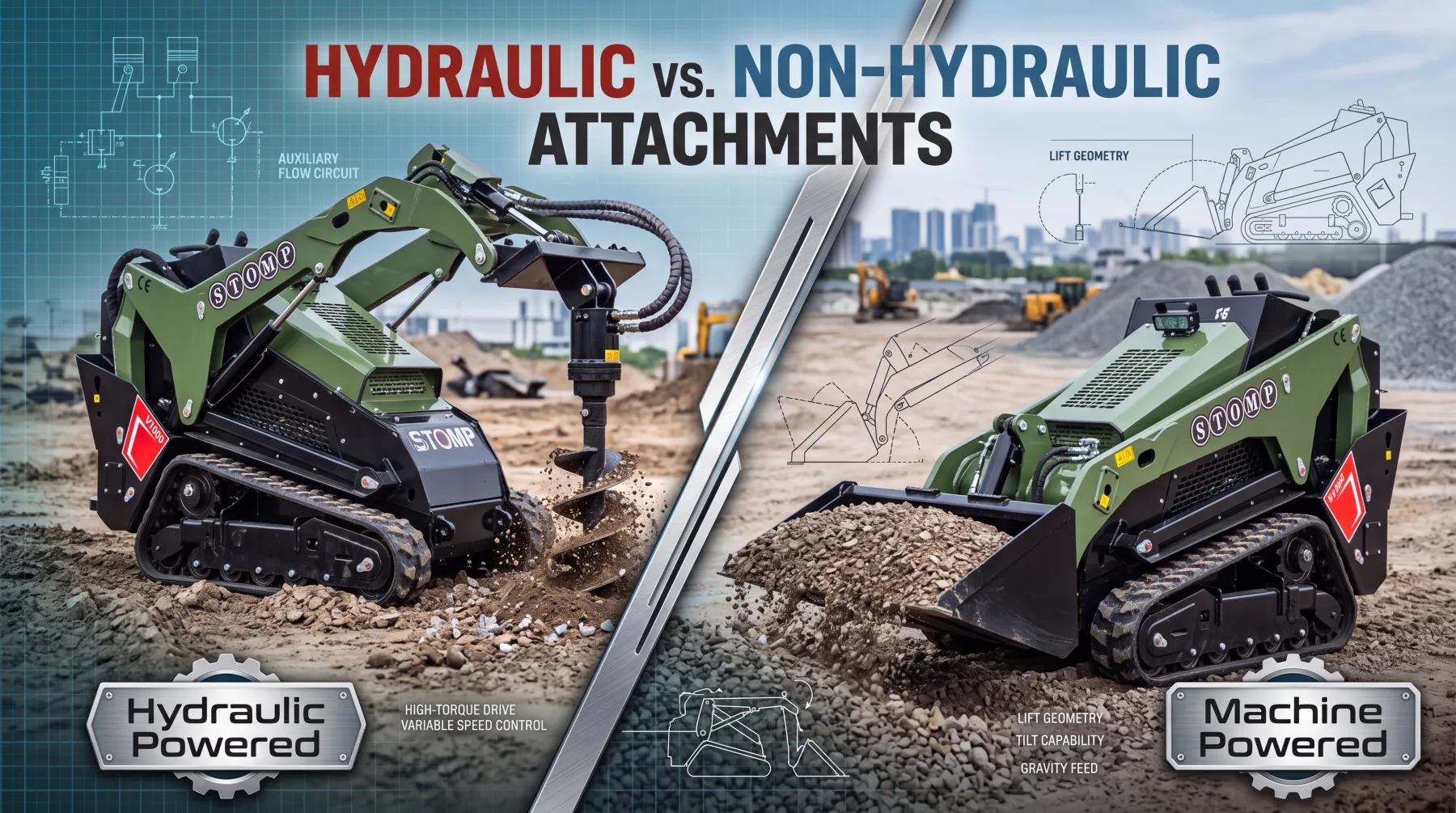
The core difference between these two attachment types comes down to how they generate movement. A non-hydraulic attachment has no powered moving parts of its own. It works purely through the skid steer’s own actions, such as lifting, tilting, pushing, and driving. When you fit a standard bucket, a set of pallet forks, or a dozer blade, the attachment simply does its job as the machine moves and the arms raise or lower. There is nothing to connect beyond the mounting plate, which keeps these tools refreshingly simple and dependable.
A hydraulic attachment, by contrast, contains its own moving components powered by the skid steer’s auxiliary hydraulic system. Hoses run from the machine’s hydraulic couplers to the attachment, feeding pressurized fluid that drives motors, cylinders, or rotating parts. This is what lets an auger spin, a breaker pound, a grapple clamp shut, or a sweeper rotate. The attachment draws on the same hydraulic power that operates the boom and bucket, turning fluid pressure into active, independent motion.
That single distinction shapes everything about how each type is used and connected:
- Non-hydraulic attachments: Rely only on the machine’s lifting, tilting, and driving motion.
- Hydraulic attachments: Use powered parts driven by the machine’s auxiliary hydraulics.
- Connection: Non-hydraulic tools mount and go; hydraulic tools require hose hookups.
Understanding this fundamental split is the starting point for every decision that follows. Non-hydraulic attachments deliver straightforward, reliable performance for tasks that only need the machine’s movement and force. Hydraulic attachments unlock a far wider range of active functions, but they depend on your skid steer having the auxiliary hydraulic capacity to run them. Knowing which power source an attachment uses tells you immediately whether your machine can handle it and what kind of work it is built to do.
Common Applications for Each Attachment Type
Hydraulic vs Non-Hydraulic Skid Steer Attachments: Key Differences
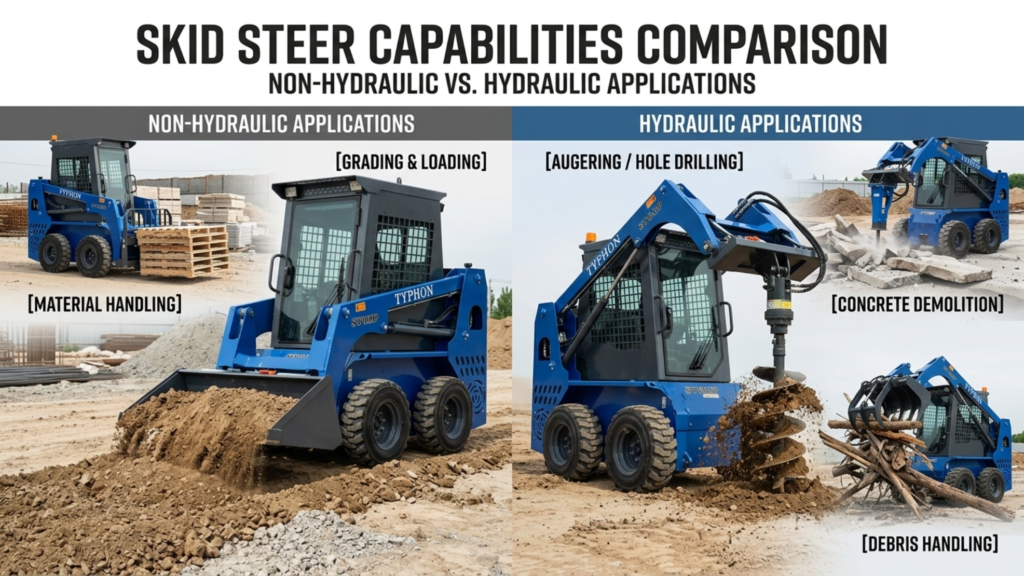
Each attachment type shines on a distinct set of jobs, and matching the tool to the task keeps your work efficient. Non-hydraulic attachments handle the fundamental material-moving and shaping work that fills most job sites. Standard buckets scoop and carry soil, gravel, and debris. Pallet forks lift and place packaged materials, while dozer and grading blades level ground and spread material with the push and tilt of the machine. These tools cover grading, material handling, and site cleanup capably, doing exactly what the skid steer’s own motion allows.
Hydraulic attachments take on the demanding, active tasks that require independent power. This is where the machine’s versatility truly expands, letting one skid steer tackle jobs that would otherwise need specialized equipment. Because these tools drive their own moving parts, they handle work that plain lifting and pushing simply cannot accomplish.
The applications for each type line up naturally with how they operate:
- Non-hydraulic: Digging with a bucket, grading and leveling, material handling, and site cleanup.
- Hydraulic: Augering holes, breaking concrete, trenching, grappling debris, and powered sweeping.
Digging and demolition illustrate the divide clearly. A standard bucket digs by driving the machine forward and curling the bucket, which suits general excavation and loading. For drilling fence-post holes, you need a hydraulic auger. For breaking up concrete or rock during demolition, a hydraulic breaker delivers the pounding force no non-hydraulic tool can match. Site cleanup follows the same logic. A bucket or blade clears loose material easily, but a hydraulic grapple clamps down on brush, logs, and irregular debris to lift and move it securely.
Knowing which category a job falls into points you straight to the right attachment. Simple moving, lifting, and shaping tasks call for dependable non-hydraulic tools, while active work like drilling, breaking, and grabbing demands the powered performance that only hydraulic attachments provide.
Performance, Power, and Productivity
Benefits of Hydraulic vs Non-Hydraulic Skid Steer Attachments
When it comes to raw capability on demanding tasks, hydraulic attachments hold a clear advantage. Because they harness the skid steer’s hydraulic power to drive their own components, they deliver active force that non-hydraulic tools cannot produce. A hydraulic breaker generates the repeated impact needed to shatter concrete, and a hydraulic auger spins with the torque required to bore through tough ground. For heavy, specialized work, this powered performance translates directly into the ability to complete jobs that would otherwise be impossible or painfully slow by hand.
Non-hydraulic attachments perform reliably within their intended scope, and their strength lies in efficiency and simplicity rather than powered force. A well-matched bucket or blade moves material quickly and consistently, with no hoses, motors, or moving parts to slow it down or absorb energy. For straightforward tasks, this simplicity often makes non-hydraulic tools the more efficient choice, since all of the machine’s power goes directly into lifting and moving rather than running an attachment’s internal components.
Productivity, then, depends heavily on matching the attachment to the workload:
- Demanding, active tasks: Hydraulic attachments deliver the power to break, drill, and grab.
- High-volume simple work: Non-hydraulic attachments move material efficiently with less complexity.
- Machine demand: Hydraulic tools draw on auxiliary flow, so the machine must supply enough.
One important performance factor is how much a hydraulic attachment demands from the machine. Each powered tool requires a certain hydraulic flow and pressure to work at its best, and a skid steer that cannot supply enough will run the attachment weakly or not at all. A machine matched to its attachment’s requirements delivers full performance, while an underpowered pairing leaves productivity on the table. For the right jobs, hydraulic attachments unlock impressive capability, but that capability only materializes when the machine can feed them properly. Non-hydraulic tools sidestep this concern entirely, delivering dependable output on the tasks they were built for.
Cost, Maintenance, and Ownership Considerations
The financial picture differs considerably between the two attachment types, starting with upfront investment. Non-hydraulic attachments are generally simpler in design, with no motors, cylinders, hoses, or seals to manufacture. That simplicity makes them more affordable to buy, so tools like buckets, forks, and blades represent a modest investment that most operations can add without much hesitation. Hydraulic attachments carry a higher price tag because their powered components, precision parts, and hydraulic hardware cost more to produce.
Maintenance follows the same pattern, and this is where long-term ownership costs really take shape. A non-hydraulic attachment has few points of wear beyond its cutting edges, teeth, or contact surfaces, so upkeep is minimal and repairs are usually simple and inexpensive. Hydraulic attachments demand more attention, since their moving parts, seals, and hose connections all wear over time and need regular inspection. Leaks, worn seals, and damaged hoses must be addressed promptly to keep the tool working and to protect the machine’s hydraulic system from contamination or pressure loss.
Weighing the full cost of ownership means looking beyond the purchase price:
- Upfront cost: Non-hydraulic tools cost less; hydraulic tools require a larger investment.
- Maintenance: Simple non-hydraulic tools need little upkeep; hydraulic tools require regular service.
- Long-term value: Hydraulic attachments justify their cost when their capability is genuinely used.
The best value depends entirely on how the attachment fits your work. A hydraulic tool that earns its keep on regular specialized jobs delivers strong return despite its higher cost and upkeep, because it replaces separate equipment and completes work nothing else can. A non-hydraulic tool, meanwhile, offers excellent value through low cost and easy maintenance for the everyday tasks it handles. Judging value honestly against your actual workload, rather than price alone, points you toward the attachment that serves your business most economically over its full life.
Choosing the Right Attachment for Your Skid Steer
Hydraulic vs Non-Hydraulic Skid Steer Attachments comparisonThe single most important factor in choosing a hydraulic attachment is your machine’s hydraulic capacity, because it determines what your skid steer can actually run. Every powered attachment needs a specific hydraulic flow and pressure to operate correctly, and skid steers vary widely in what their auxiliary systems provide. Some tools require high-flow hydraulics that standard machines cannot supply, so before you buy, confirm that your skid steer’s flow and pressure match the attachment’s requirements. Matching these specifications is what separates full performance from a tool that runs poorly or refuses to work at all. Non-hydraulic attachments avoid this concern entirely, needing only a compatible mounting plate.
Job requirements and budget shape the decision just as strongly. Look honestly at the work you do most often, since active tasks like drilling, breaking, and grappling demand hydraulic tools, while moving, lifting, and shaping call for simpler non-hydraulic ones. Your budget then frames the choice further, weighing the higher purchase and maintenance cost of hydraulic attachments against the affordability of non-hydraulic options.
Weigh these key factors before you commit:
- Hydraulic capacity: Confirm your machine’s flow and pressure meet the attachment’s needs.
- Job requirements: Match the attachment type to the tasks you perform most often.
- Budget: Account for both upfront cost and ongoing maintenance.
- Future versatility: Consider whether powered attachments will expand your capabilities down the road.
Future versatility is worth serious thought, especially if your work is growing or changing. Investing in a skid steer with strong auxiliary hydraulics, and in hydraulic attachments that broaden what you can take on, positions your operation to handle a wider range of jobs as opportunities arise. The right choice ultimately balances what your machine can power, what your work demands, what your budget allows, and where your business is headed. Assess those factors together, and you will build an attachment lineup that serves your skid steer and your projects dependably.
Conclusion
The difference between hydraulic and non-hydraulic skid steer attachments comes down to power and purpose. Non-hydraulic tools rely on the machine’s own lifting and pushing motion, offering simple, affordable, low-maintenance performance for digging, grading, material handling, and cleanup. Hydraulic attachments use the machine’s auxiliary system to drive powered parts, unlocking demanding work like drilling, breaking, and grappling at a higher cost and with greater upkeep. Neither type is better overall, because the right choice depends on your machine’s hydraulic capacity, the jobs you tackle most often, your budget, and your plans for the future. Assess those factors honestly, match each attachment to your machine and your work, and you will build a versatile, dependable setup that gets every job done efficiently.