

Best Skid Steer for Small Construction Businesses
Running a small construction business requires maximizing every single dollar and minute. You operate on strict timelines with tight profit margins. When it comes to building your equipment fleet, you need machinery that delivers uncompromising reliability and exceptional return on investment. The skid steer loader stands as the absolute foundation of a successful small construction operation.
Choosing the right equipment determines how efficiently your crew completes daily tasks. A perfectly matched skid steer acts as a force multiplier, allowing a small team to perform the work of a much larger crew. We understand that purchasing heavy machinery represents a massive financial commitment for growing contractors. You need total confidence that your investment will perform consistently under demanding conditions.
This comprehensive guide details exactly how to identify the best skid steer for small construction businesses. We will explore the core benefits that make these machines indispensable, including their compact size, versatility, and overall affordability. We will also highlight specific models perfectly engineered for small-scale operations, giving you the expert knowledge needed to make a highly profitable purchasing decision.
Why Small Contractors Rely on Skid Steers
Heavy equipment must earn its keep every single day on your job site. Skid steers achieve this by offering a unique combination of power and agility that larger machines simply cannot match. For a small business, this combination directly translates into faster project completion times and higher customer satisfaction.
Compact Size for Tight Workspaces
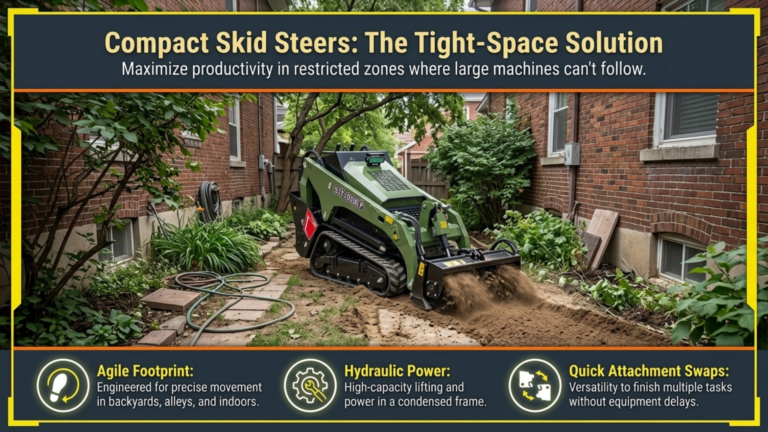
Small construction businesses frequently operate in residential neighborhoods or cramped urban job sites. Massive excavators and full-sized wheel loaders simply will not fit into these restricted areas. You need equipment that maneuvers effortlessly through narrow alleyways, standard fence gates, and crowded backyards.
Skid steers deliver exceptional power within a highly compact footprint. Because they steer by skidding their wheels or tracks, they can turn a complete 360 degrees within their own length. This zero-turn capability allows your operators to navigate complex job sites without damaging existing structures or delicate residential landscaping. You complete the job efficiently without causing costly collateral damage.
Unmatched Versatility Through Attachments
Buying a single-purpose machine rarely makes financial sense for a small contractor. You need equipment that adapts to the changing demands of your project schedule. Skid steers serve as versatile tool carriers, transforming from a loading machine into a trenching tool in mere minutes.
By investing in a quick-attach system and a variety of hydraulic attachments, you multiply your capabilities. A standard bucket handles grading and material moving. A grapple bucket makes short work of demolition debris and brush clearing. Augers, trenchers, and pallet forks allow your single skid steer to perform the work of five different machines. This unmatched versatility keeps your equipment active and profitable all year long.
Cost-Effective Affordability and Transport
Capital allocation remains a constant challenge for growing construction firms. Skid steers require a significantly lower initial investment compared to heavy excavators or full-sized bulldozers. This affordability allows small businesses to purchase reliable, professional-grade equipment without overextending their credit lines.
Furthermore, transportation costs directly impact your bottom line. Massive construction equipment requires expensive commercial haulers and specialized oversized load permits. In contrast, you can easily tow a standard skid steer using a heavy-duty pickup truck and a standard equipment trailer. Eliminating expensive third-party transportation fees drastically reduces your daily overhead costs.
Evaluating Tracked vs. Wheeled Machines
Before selecting a specific model, you must decide between a wheeled skid steer and a compact track loader (CTL). While they operate using similar controls, their undercarriages dictate where and how they perform best. We highly recommend evaluating your most common job site conditions before making this critical choice.
Wheeled Skid Steer Loaders
Wheeled skid steers excel on hard, flat surfaces like concrete, asphalt, and highly compacted dirt. They offer faster top travel speeds, allowing your crew to move materials quickly across large, paved yards. If your business focuses on demolition, concrete removal, or street-level hardscaping, a wheeled machine provides excellent performance.
Additionally, wheeled machines cost significantly less to purchase and maintain. Replacing four heavy-duty pneumatic or solid tires costs a fraction of what you would pay to replace specialized rubber tracks. We advise contractors working primarily on solid ground to choose wheeled models to keep long-term maintenance costs low.
Compact Track Loaders (CTL)
If your small business handles grading, excavation, or land clearing, you will frequently encounter soft mud and uneven terrain. Compact track loaders feature wide rubber tracks that distribute the machine’s weight over a large surface area. This low ground pressure prevents the machine from sinking into wet clay or loose sand.
CTLs provide superior traction and pushing power compared to wheeled variants. They allow your crew to keep working immediately after a heavy rainstorm, preventing costly weather-related delays. While they command a higher upfront price and require more expensive undercarriage maintenance, their ability to work in adverse conditions often justifies the premium for earthmoving contractors.
Best Skid Steer Models for Small Operations
Equipment manufacturers design specific machines that hit the perfect sweet spot between lifting capacity, physical size, and overall price. We have identified several standout models that consistently deliver exceptional value for small construction businesses.
Bobcat S66 Skid-Steer Loader
Bobcat practically invented the skid steer industry, and their machines remain incredibly popular for good reason. The Bobcat S66 represents an ideal medium-frame wheeled loader for growing contractors. It features a robust 74-horsepower engine and a rated operating capacity (ROC) of 2,400 pounds.
The S66 utilizes a vertical lift path, providing excellent reach at maximum height. This makes it perfect for loading high-sided dump trucks or stacking heavy pallets of brick and block. The machine remains compact enough to navigate standard residential driveways, yet powerful enough to handle serious commercial hardscaping materials.
Caterpillar 232D3 Skid Steer
Caterpillar brings heavy-duty mining and highway construction pedigree to their compact equipment line. The Cat 232D3 serves as an outstanding entry-level to mid-tier machine for small contractors. It features a 67-horsepower engine and an ROC of 1,850 pounds, making it highly fuel-efficient and easy to transport.
We recommend the 232D3 for its exceptional operator comfort. Caterpillar designs some of the quietest, best-sealed cabs in the industry. When your operators remain comfortable, they remain focused and highly productive throughout long, demanding shifts. The machine also features advanced display screens that make tracking maintenance intervals incredibly straightforward for business owners.
Kubota SVL75-2 Compact Track Loader
If your operations demand a tracked machine, the Kubota SVL75-2 dominates the medium-frame CTL market. This machine features a powerful 74.3-horsepower engine and an impressive ROC of 2,300 pounds. Kubota engines are legendary for their longevity and reliability under extreme stress.
The SVL75-2 features a unique roll-up front door, allowing operators to work with the door open regardless of the loader arm position. This design provides excellent communication between the operator and the ground crew. With its massive breakout force and wide tracks, this machine serves as a perfect primary earthmover for small excavation and landscaping companies.
John Deere 318G Skid Steer
John Deere designed the G-Series specifically to meet the needs of smaller contractors who require simplicity and durability. The 318G provides 65 horsepower and an ROC of 1,945 pounds. It utilizes a radial lift boom, which provides superior forward reach at eye level, making it exceptional for digging and grading.
This machine focuses on serviceability. John Deere engineered the 318G with easily accessible daily checkpoints and a tilt-up hood that exposes the entire engine compartment. For small businesses that handle their own routine maintenance to save money, this easy access drastically reduces downtime and keeps the machine out on the job site generating revenue.
Maximizing Your Equipment Investment
Purchasing the right skid steer only represents the first step. You must manage the asset properly to ensure it delivers a high return on investment over its entire lifespan. Implementing strict operational standards protects your capital and builds a highly professional reputation.
Commit to Preventative Maintenance
Small businesses cannot afford unexpected breakdowns. When your only skid steer fails, your entire project halts, and labor costs skyrocket as your crew stands idle. You must establish a rigid, non-negotiable preventative maintenance schedule.
Require your operators to perform a thorough visual inspection before every single shift. They must check hydraulic fluid levels, engine oil, and tire pressure or track tension. Address minor issues like small hydraulic leaks or worn hoses immediately, before they escalate into catastrophic mechanical failures. Documenting every service interval also ensures you maintain a high resale value when you eventually upgrade your fleet.
Match the Machine to the Task
Never push a compact machine past its engineered limits. If you purchase a small-frame skid steer with a 1,500-pound ROC, do not attempt to lift a 2,500-pound pallet of pavers. Overloading the equipment damages the hydraulic cylinders, prematurely wears the tires, and creates a severe safety hazard on your site.
If you occasionally land a massive project that requires heavy lifting, consider renting a large-frame skid steer specifically for that job. Renting allows you to utilize the exact tool you need without taking on the permanent financial burden of purchasing a massive machine. Reserve your purchased equipment for the daily, core tasks that generate your most consistent revenue.
Take Control of Your Job Site Productivity
Building a highly successful small construction business requires outfitting your team with reliable, versatile equipment. A properly sized skid steer loader delivers the raw power and compact agility necessary to tackle demanding projects efficiently. By carefully evaluating your typical terrain, selecting the right lift capacity, and prioritizing preventative maintenance, you guarantee a strong return on your equipment investment.
We encourage you to contact local equipment dealers to schedule hands-on demonstrations of the models we discussed. Sit in the cabs, operate the controls, and evaluate the visibility for yourself. When you equip your business with a professional-grade skid steer, you empower your crew to deliver exceptional results safely, rapidly, and profitably.

I like this skid steer