

Wheel Loader Mechanics: Mastering Technical Metrics
A wheel loader spec sheet is packed with numbers, and each one tells you something important about how the machine will perform on your job site. Yet many buyers and operators skim past those figures, focusing only on horsepower or bucket size while overlooking the metrics that actually determine safety, productivity, and long-term value. Understanding what each specification means, and how they work together, is what separates a confident equipment decision from an expensive guess. When you know how to read operating weight against rated load, or how flow rate shapes bucket response, you can match a machine precisely to the work in front of it. This guide breaks down five essential areas of wheel loader mechanics: operating weight and load capacity, engine power and hydraulic performance, bucket specifications, travel and maneuverability, and how to use all of it to compare models. Master these metrics, and you will get more work done safely while protecting your investment.
Understanding Operating Weight and Load Capacity
Operating weight, rated load, and tipping load are three of the most important numbers on any wheel loader spec sheet, and they only make sense when you read them together. Operating weight is the total weight of the machine ready to work, including fluids and an operator. This figure anchors everything else, because a heavier machine generally provides more stability and counterbalance when lifting a loaded bucket. Rated load, sometimes called rated operating capacity, tells you how much the loader can safely lift and carry as a percentage of its tipping load. Tipping load is the point at which the machine would begin to tip forward under a load, and it changes depending on whether the loader is traveling straight or turning.
The relationship between these three metrics is what determines safe, productive operation. Manufacturers typically set the rated load well below the tipping load to build in a safety margin, and understanding that margin protects both your crew and your machine. A few points are worth keeping in mind:
- Tipping load drops when the machine turns, so a loader that feels stable driving straight can become unstable in a full articulation turn with a heavy bucket.
- Ground conditions change real-world stability, since soft, uneven, or sloped surfaces reduce the effective safety margin the spec sheet promises.
- Operating weight influences traction and push power, not just balance, which matters when digging into a pile.
Reading these figures in context keeps you working within safe limits while maximizing output. If you consistently handle dense material like wet gravel, you need a machine whose rated load comfortably exceeds your typical bucket weight, with room to spare for turning and rough terrain. Choosing a loader whose capacity barely meets your needs invites instability, faster wear, and safety risks. Matching operating weight and load capacity to your actual conditions is the foundation of dependable performance.
Interpreting Engine Power and Hydraulic Performance
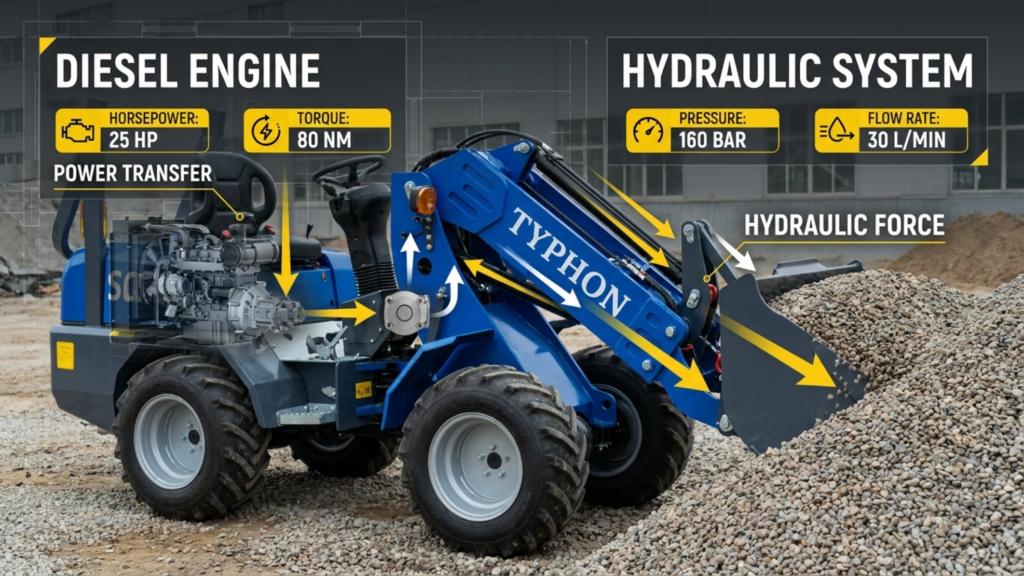
Engine power and hydraulic performance work as a team, and neither one alone tells the full story of how a wheel loader will perform under load. Horsepower measures the engine’s overall output and largely determines travel speed and how quickly the machine responds. Torque, on the other hand, is the rotational force that gives the loader its pushing and digging strength. A machine with strong low-end torque drives into a pile with authority and maintains power under heavy resistance, which matters far more during demanding tasks than peak horsepower numbers alone. When you evaluate an engine, look at how torque is delivered across the RPM range, not just the maximum figure.
The hydraulic system is where engine power becomes useful work at the bucket. Two metrics govern hydraulic performance, and understanding both helps you predict real-world behavior:
- Hydraulic pressure determines the raw force available for lifting and breaking out material, directly affecting how much weight the arms can raise.
- Flow rate controls how fast the hydraulic functions operate, so higher flow means quicker lift, tilt, and bucket response during rapid loading cycles.
Together, pressure and flow shape both the strength and the speed of every movement the loader makes.
Balancing these systems is what produces an efficient, responsive machine. An engine with ample torque paired with a well-matched hydraulic system lets the loader dig, lift, and dump in smooth, fast cycles without bogging down. If the hydraulics cannot keep pace with the engine, or the engine lacks the torque to sustain hydraulic demand, you end up with sluggish response and wasted fuel. During tough tasks like loading dense material or working on a grade, this balance becomes obvious, because a well-engineered machine holds its speed and power while a mismatched one struggles. Reading engine and hydraulic specs together gives you a realistic picture of productivity and efficiency.
Reading Bucket Specifications and Performance Metrics
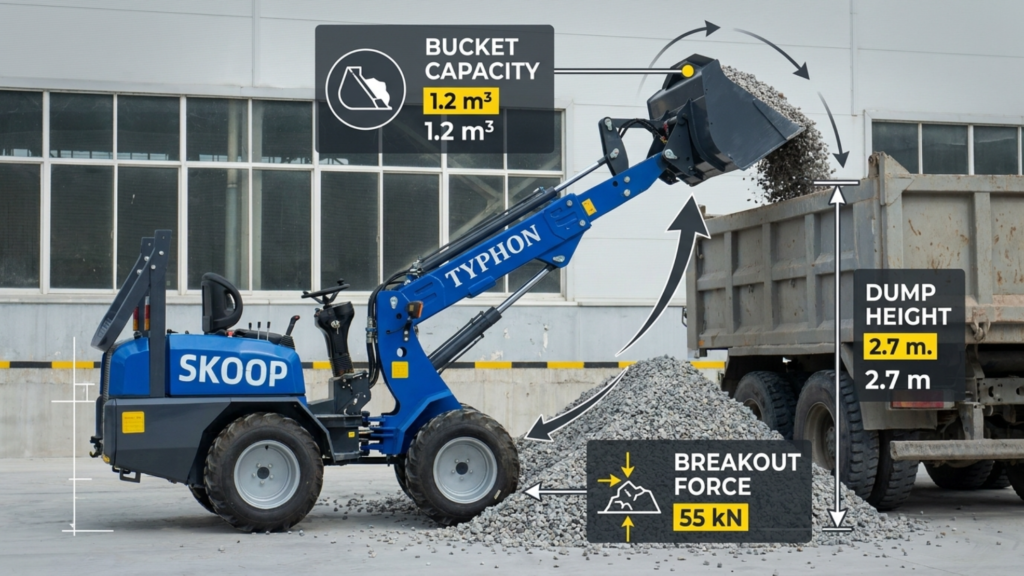
The bucket is where a wheel loader does its most visible work, and three metrics reveal how well it will handle your material: bucket capacity, breakout force, and dump height. Bucket capacity, measured in cubic yards or cubic meters, tells you how much material the bucket holds in a single pass. Larger capacity means fewer cycles to fill a truck, which improves productivity, but only if the machine has the weight and power to lift a full bucket safely. Matching bucket capacity to both the loader’s rated load and the density of your material is essential, since an oversized bucket filled with heavy material can push the machine past its safe limits.
Breakout force measures the maximum digging force the bucket can generate to pry material loose from a pile or the ground. This metric matters most when you work with compacted, dense, or stubborn material that resists penetration. A loader with strong breakout force digs cleanly into a pile and fills the bucket in one smooth motion, while a machine that comes up short forces extra passes and slows the cycle. Dump height, meanwhile, tells you how high the bucket can be raised and tilted to unload, which directly affects whether you can clear the sides of the trucks and hoppers you load.
These specifications work together to define loading cycle efficiency. Consider the whole picture rather than any single number:
- Bucket capacity sets how much you move per pass.
- Breakout force determines how quickly and cleanly you fill that bucket.
- Dump height confirms you can unload into your target equipment without repositioning.
When capacity, breakout force, and dump height all suit your material and your loading targets, the loader completes fast, efficient cycles. When even one falls short, the whole operation slows, so read these metrics as a connected set tied to the specific materials and trucks you work with every day.
Evaluating Travel, Steering, and Maneuverability
How a wheel loader moves is just as important as how it lifts, and four metrics shape its mobility: travel speed, turning radius, wheelbase, and ground clearance. Travel speed determines how quickly the machine covers ground between the loading point and the dump target. On sites with long haul distances, a higher top speed noticeably improves cycle times, while on tight, congested sites, controllability at lower speeds matters more. Turning radius tells you how tightly the loader can maneuver, which becomes critical in confined spaces where a wide turning circle forces extra back-and-forth movement that wastes time and fuel.
Wheelbase and ground clearance influence both stability and the terrain a loader can handle. A longer wheelbase generally delivers a smoother, more stable ride and better load-carrying balance, though it can slightly reduce agility in tight quarters. Ground clearance determines how easily the machine navigates rough, rocky, or uneven surfaces without dragging its underside or catching on obstacles. Together these figures tell you a great deal about where a loader will thrive:
- Confined indoor or urban sites reward a tight turning radius and compact dimensions over raw speed.
- Large open sites with long hauls benefit from higher travel speed and a stable, longer wheelbase.
- Rough or rocky terrain demands generous ground clearance to avoid damage and maintain traction.
Matching these mobility metrics to your operating environment keeps the machine productive and protected. A loader chosen for a spacious quarry may perform poorly inside a crowded recycling facility, and a compact, agile machine may lack the speed and clearance a sprawling site requires. Before you commit, picture the machine moving through your actual work area, accounting for the tightest turns, the longest hauls, and the roughest ground it will face. Getting travel, steering, and maneuverability right ensures the loader moves efficiently and safely in the conditions you actually work in.
Using Technical Metrics to Compare Wheel Loader Models
Once you understand what each specification means, the real skill is knowing which metrics matter most for your particular operation when comparing models. No single machine wins on every figure, so effective comparison starts with defining your priorities. A loader built for maximum lifting capacity may sacrifice agility, while a nimble, fast machine may lack the breakout force for dense material. Rather than chasing the highest number in every category, weigh the specifications against the work you do most often. This disciplined approach turns an overwhelming spec sheet into a clear, confident decision.
Focus your comparison on the metrics tied directly to your workload, environment, and productivity goals. Different priorities call for different emphasis:
- Heavy, dense material handling puts rated load, operating weight, breakout force, and torque at the top of the list.
- High-volume loading with long hauls prioritizes bucket capacity, travel speed, and hydraulic flow rate for fast cycles.
- Tight or indoor work areas elevate turning radius, machine dimensions, and controllability above raw power.
- Rough or variable terrain makes ground clearance, wheelbase, and traction the deciding factors.
Comparing machines through this lens keeps you from overpaying for capability you will not use, or worse, buying a loader that falls short where it counts.
The most reliable comparisons account for how metrics interact rather than judging them in isolation. A large bucket paired with insufficient rated load creates a safety problem, and strong horsepower undermined by weak hydraulics produces disappointing performance. Read the spec sheet as an interconnected system, checking that lifting capacity, power, bucket performance, and mobility all align with each other and with your demands. When you match the full profile of a machine to your workload, operating environment, and productivity targets, you choose a wheel loader that delivers dependable value and performs exactly as your operation needs.
Conclusion
Mastering wheel loader technical metrics gives you the confidence to select, operate, and compare machines with genuine precision. Operating weight, rated load, and tipping load define safe and stable lifting, while engine torque and hydraulic pressure and flow determine how strongly and smoothly the machine works. Bucket capacity, breakout force, and dump height reveal how efficiently it handles your material, and travel speed, turning radius, wheelbase, and ground clearance show how well it will move through your site. The key is reading these figures together as a connected system rather than in isolation, then weighing them against your real workload and conditions. Take the time to understand what each number means for your operation, and you will invest in a wheel loader that performs safely, efficiently, and reliably for years of demanding work.
2. Fully Optimized Content Draft
Wheel Loader Specifications: Mastering Technical Metrics
Evaluating wheel loader specifications is the most critical step a buyer or operator can take, as these numbers tell you exactly how a heavy machine will perform on your job site. Yet many buyers skim past these figures, focusing only on engine horsepower or bucket size while overlooking the metrics that actually determine safety, productivity, and long-term asset value.
Understanding what each metric means, and how they work together, is what separates a confident equipment decision from an expensive guess. This comprehensive guide breaks down essential performance metrics so you can read any manufacturer spec sheet with absolute precision.
Analyzing Weight and Load Capacity in Wheel Loader Specifications
Operating weight, rated load, and tipping load are three of the most vital metrics found within wheel loader specifications, and they only make sense when you evaluate them together. Operating weight is the total weight of the machine ready to work, including fluids and an operator. This figure anchors everything else because a heavier machine generally provides more stability and counterbalance when lifting a loaded bucket.
Visual Reference: For a complete structural breakdown of these balance physics, view our detailed engineering diagram:
[https://img.miniexcavator.org/ebay/Website-Team/Class2-July/16-july/b5-01.webp](https://img.miniexcavator.org/ebay/Website-Team/Class2-July/16-july/b5-01.webp)(Alt Text: Detailed diagram illustrating wheel loader specifications for operating weight and forward tipping load limits.)
Rated load, sometimes called rated operating capacity, tells you how much the loader can safely lift and carry as a percentage of its tipping load. Tipping load is the point at which the machine would begin to tip forward under a load. Reviewing these wheel loader specifications in context keeps your crew working within safe operating limits:
- Tipping load drops significantly when the machine turns or fully articulates.
- Soft, uneven, or sloped ground conditions drastically reduce your effective safety margins.
- Operating weight directly influences tire traction and ground-penetrating push power.
If your project requires handling dense materials like wet gravel, you can consult our heavy equipment application guide to cross-reference material density weights against your machine’s rated capacity limits.
Engine Power and Hydraulic Systems in Wheel Loader Specifications
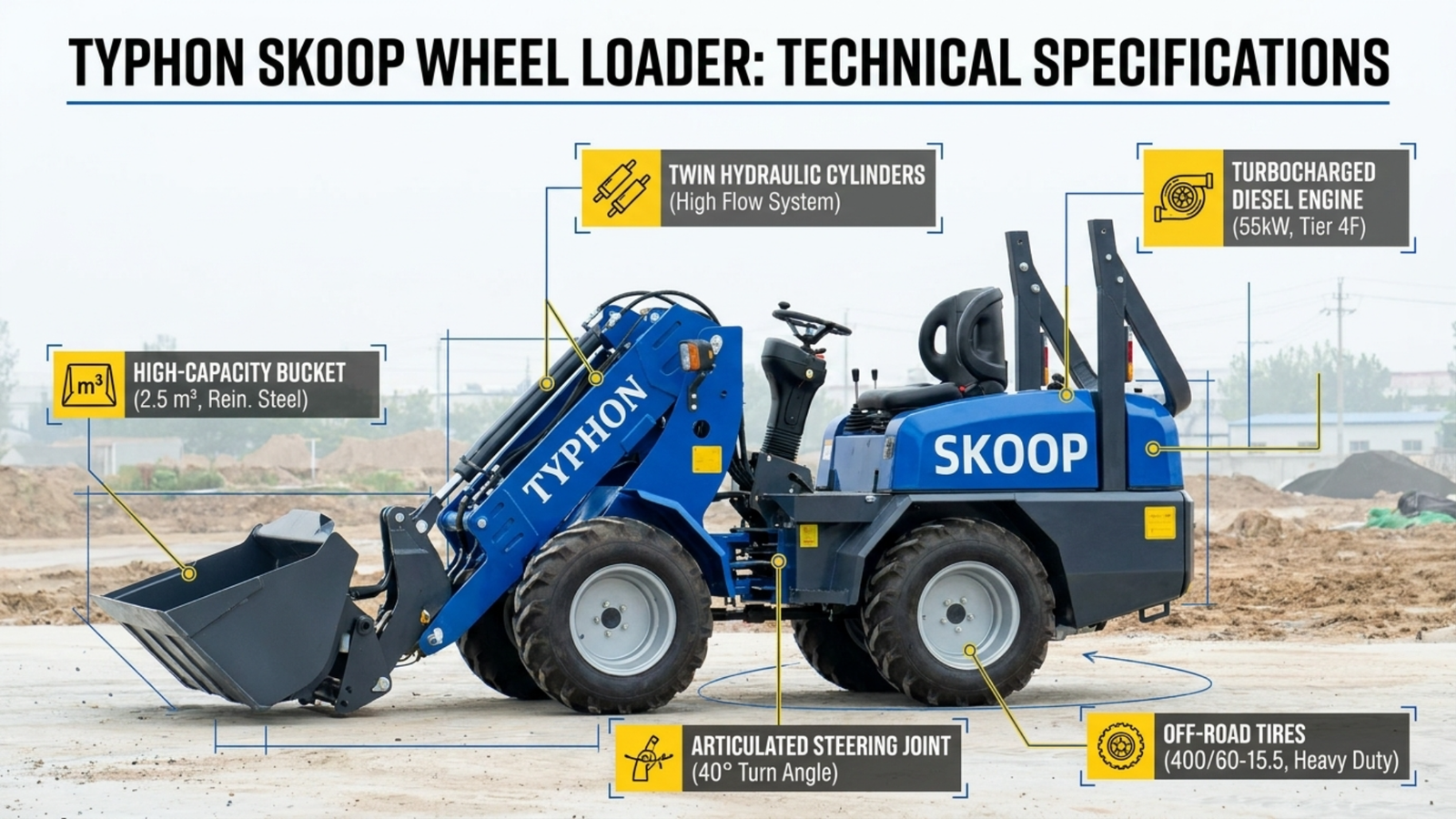
Engine power and hydraulic performance work as a team; neither one alone tells the full story of how a machine handles heavy workloads. While horsepower measures the engine’s overall power output, low-end torque is the rotational force that gives a loader its digging power. When you compare different wheel loader specifications, look closely at how torque is delivered across the RPM range rather than just focusing on the maximum peak horsepower figure.
The hydraulic system is where that engine power transforms into measurable mechanical work at the front linkage. Two core metrics govern this system on a standard spec sheet:
- Hydraulic Pressure: Determines the raw breakout force available for lifting and breaking out material.
- Flow Rate: Controls the fluid speed, directly dictating how fast the arms lift, tilt, and complete loading cycles.
For a deeper technical deep dive into system hydraulics, you can check out the fluid engineering standards provided by the International Organization for Standardization (ISO) to see how heavy machinery testing protocols are established globally.
Evaluating Front-End Performance in Wheel Loader Specifications
The bucket assembly is where the machine interacts directly with the material, making front-end metrics crucial to your daily production rates. Standard wheel loader specifications break this down into three essential numbers: bucket capacity, breakout force, and maximum dump height. Bucket capacity tells you how much material the bucket holds in a single pass, but an oversized bucket filled with heavy material will quickly overload a machine if it exceeds the rated load limits.
Breakout force measures the maximum digging force the bucket cylinders can generate to pry material loose from a compacted pile. A loader with strong breakout force digs cleanly and fills the bucket in one smooth motion, while a machine that comes up short forces extra passes and slows your cycle times. Finally, dump height confirms whether your loader arms can physically clear the sides of the haul trucks or hoppers you intend to fill.
Mobility Metrics: Travel, Steering, and Maneuverability
How a wheel loader moves across a job site is just as important as how much weight it can lift. Mobility metrics on a spec sheet are shaped by four distinct parameters: travel speed, turning radius, wheelbase, and ground clearance. Travel speed dictates how quickly the machine covers ground between the pile and the dump target, which directly impacts cycle times during long-distance hauling applications.
Turning radius tells you how tightly the loader can maneuver in tight quarters, while the wheelbase and ground clearance influence stability and rough-terrain navigation. A longer wheelbase delivers a much smoother, more stable ride, whereas generous ground clearance protects the undercarriage from structural damage when traveling over rocky, unlevel terrain.
How to Compare Wheel Loader Specifications for Your Site
Once you know what these figures mean, the real skill is knowing how to cross-reference them when comparing different models. No single machine wins in every category, so effective comparison starts with defining your job site priorities:
- Heavy Material Handling: Prioritize operating weight, low-end engine torque, and breakout force.
- High-Volume Stockpiling: Prioritize bucket capacity, travel speed, and high hydraulic flow rates.
- Confined Spaces: Prioritize a tight turning radius and compact overall machine dimensions.
The most reliable equipment comparisons account for how these metrics interact rather than judging them in isolation. A large bucket paired with an insufficient operating weight creates an immediate safety risk, just as strong horsepower undermined by weak hydraulic flow rates produces sluggish performance.