

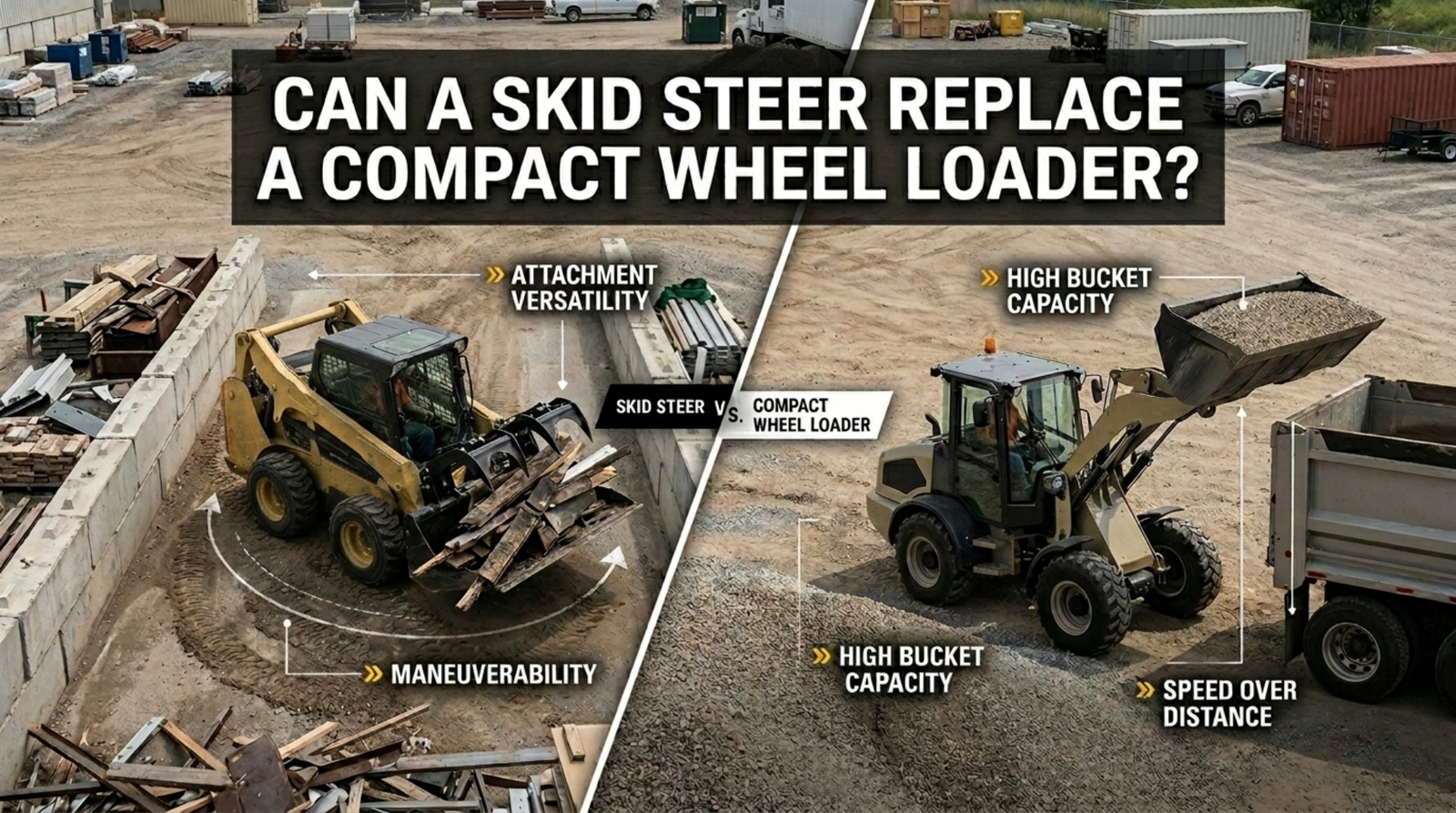
Can a Skid Steer Replace a Compact Wheel Loader?
Skid steers and compact wheel loaders often show up on the same shortlist when a contractor, farmer, or property owner needs a versatile machine that loads, digs, and hauls. On the surface, they look like they do the same work, and in many situations their jobs overlap. But each machine is built around a different set of strengths, and picking the wrong one can cost you time, fuel, and money on every project. So can a skid steer truly replace a compact wheel loader? This post breaks down how the two compare across size and maneuverability, lifting capacity, attachment versatility, job site conditions, and how to choose the machine that fits your work best.
Size and Maneuverability
When space is tight, the skid steer is hard to beat. Its compact frame and famously short turning radius let it work in places a compact wheel loader simply can’t reach. Because most skid steers turn by driving their wheels or tracks at different speeds, they can spin nearly in place, pivoting within their own footprint. That ability makes them ideal for narrow job sites, indoor work, tight alleys between buildings, and crowded areas where every foot counts. If your work regularly puts you in confined spaces, a skid steer’s agility is a genuine advantage.
A compact wheel loader takes a different approach to moving through a site. Most models use articulated steering, meaning the machine bends in the middle to change direction. This gives it a smooth, stable turn and a comfortable ride, but it also means the loader needs more room to maneuver than a skid steer does.
The trade-offs between the two tend to break down like this:
- Skid steers excel in tight, confined spaces and can turn within a very small area.
- Compact wheel loaders need more room but travel more smoothly over distance and turn with less ground disturbance.
- Articulated steering on the loader is gentler on finished surfaces, since it doesn’t scrub or skid the tires during turns.
That last point matters more than many people expect. A skid steer’s turning method can tear up soft grass, gravel, or delicate surfaces, while a compact wheel loader’s articulated design leaves those surfaces cleaner. So while the skid steer wins outright on pure maneuverability in cramped quarters, the compact wheel loader offers a more refined way of moving around open sites. Understanding where you’ll actually be working is the first step in deciding whether one can stand in for the other.
Lifting Capacity and Material Handling
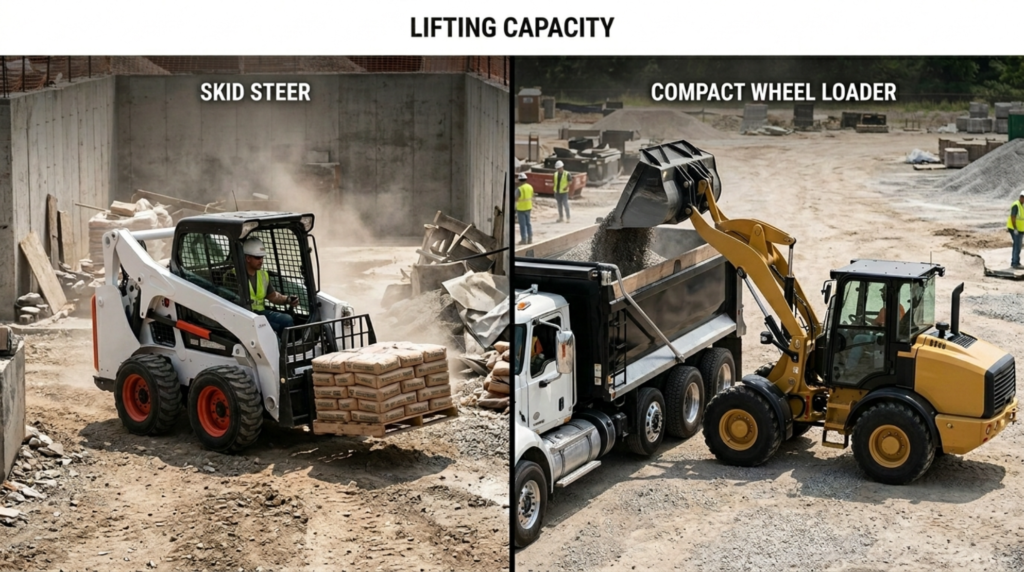
Lifting and moving material is where the differences between these two machines become clear. Compact wheel loaders are generally built to handle heavier loads and move larger volumes of material efficiently. Their design, weight distribution, and hydraulics are geared toward productive loading work, which is why they shine when filling trucks, moving big stockpiles, and handling dense materials day after day. If moving heavy material quickly is your priority, the compact wheel loader usually has the edge.
Skid steers are capable material handlers in their own right, but they operate within tighter limits. Rated operating capacity, the safe amount a machine can lift, tends to be lower on a skid steer than on a comparably sized wheel loader. Breakout force, which measures how well the machine can dig into and pry material loose, also differs between the two, with each machine performing best on the tasks it was designed for.
A few practical differences stand out when comparing how they handle material:
- Rated operating capacity is typically higher on a compact wheel loader, allowing heavier loads per cycle.
- Bucket size and reach favor the wheel loader when loading tall trucks or hoppers, thanks to greater lift height.
- Breakout force varies by machine and configuration, so matching the tool to the material matters.
The height factor deserves special attention. Compact wheel loaders generally lift higher, which makes loading over the side walls of a dump truck faster and cleaner. A skid steer can load trucks too, but its lower reach can slow the process or limit which trucks it can serve. For occasional, lighter loading in tight spaces, a skid steer performs well. For steady, high-volume loading of heavy material, though, a compact wheel loader’s greater capacity and reach translate directly into more work completed per hour.
Attachment Versatility
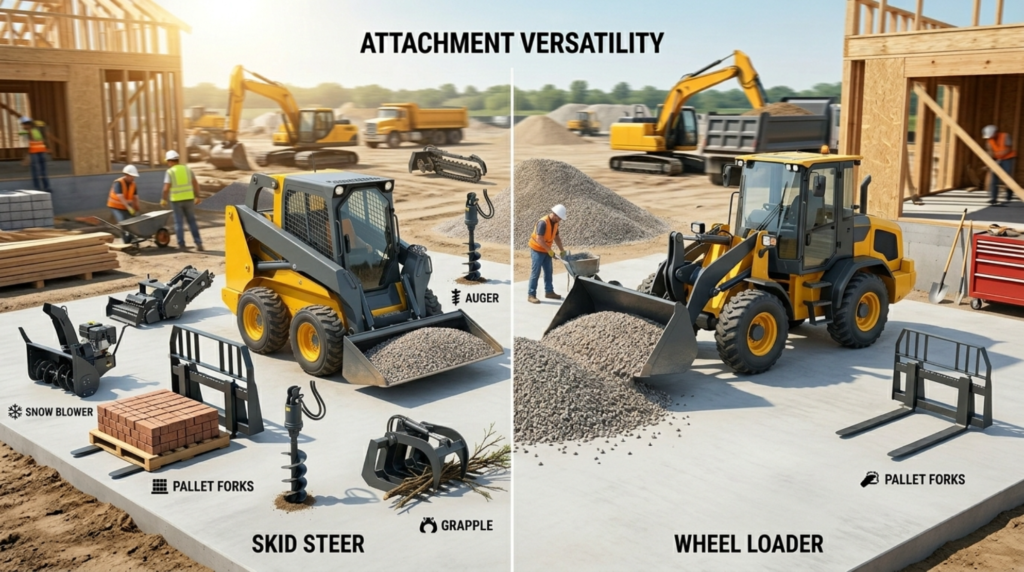
If versatility is what you’re after, the skid steer makes a strong case for itself. Its greatest strength isn’t just loading; it’s the enormous range of attachments it can run. With a quick-attach system and auxiliary hydraulics, a single skid steer transforms into many different machines, tackling jobs far beyond basic material handling. This adaptability is a major reason skid steers are so popular across construction, landscaping, farming, and property maintenance.
The list of available attachments is remarkable, and it lets one machine cover a wide spread of tasks:
- Buckets and pallet forks for standard loading and lifting.
- Augers for drilling post holes and footings.
- Trenchers for cutting clean utility and drainage lines.
- Brush cutters and mulchers for clearing overgrown land.
- Grapples for handling logs, brush, and debris.
- Breakers, sweepers, and snow blades for demolition, cleanup, and seasonal work.
Few machines can match that breadth from a single compact platform.
Compact wheel loaders accept attachments too, and many run buckets, forks, and other useful tools effectively. However, their attachment ecosystem is generally narrower than the skid steer’s, and they’re most often used for loading and material-handling roles. Where a skid steer can serve as an all-in-one tool carrier that swaps functions throughout the day, a compact wheel loader is more of a dedicated loading specialist that occasionally takes on other tasks. For an operation that needs one machine to dig in the morning, clear brush at midday, and move material in the afternoon, the skid steer’s versatility is genuinely hard to replace. This flexibility is often the deciding factor for buyers who want maximum return from a single piece of equipment rather than a fleet of specialized machines.
Jobsite Conditions and Terrain
The ground you work on has a big influence on which machine performs better. Compact wheel loaders, riding on rubber tires and using articulated steering, tend to handle rough and uneven outdoor terrain comfortably. Their design provides good stability and a smooth ride across longer distances, and they cope well with the demands of open construction sites, quarries, and agricultural settings. On solid, uneven ground, a compact wheel loader delivers dependable traction and steady performance.
Skid steers respond to terrain based heavily on whether they run on wheels or tracks. Wheeled skid steers work well on firm, hard surfaces but can struggle on soft, muddy, or loose ground, where their tires may spin or sink. Tracked skid steers, by contrast, spread the machine’s weight over a larger area, giving them excellent flotation and traction on soft soil, sand, mud, and even snow. This makes a tracked machine a strong performer in conditions that would bog down a wheeled one.
A few terrain considerations help clarify the comparison:
- Soft or muddy ground favors a tracked skid steer, thanks to superior flotation and grip.
- Firm, uneven outdoor terrain suits a compact wheel loader’s stable, articulated design.
- Slopes and inclines demand caution with either machine, though weight distribution and traction differ between them.
Slopes call for particular care regardless of which machine you choose, since operating capacity and stability both change on a grade. On demanding outdoor sites with mixed conditions, the choice often comes down to the specific challenges you face most. If you regularly cross soft, wet ground, a tracked skid steer may outperform a wheel loader. If your work spans firm, rugged terrain over larger areas, the compact wheel loader’s ride and traction make it a reliable workhorse. Matching the machine’s design to your typical ground conditions protects both productivity and safety.
Choosing the Right Machine for Your Work
Deciding whether a skid steer can replace a compact wheel loader comes down to an honest look at the work you do most. A skid steer can effectively fill the wheel loader’s role when your projects involve tight spaces, lighter to moderate loads, and a wide variety of tasks that benefit from swapping attachments. For contractors and property owners who value versatility and maneuverability above raw loading power, a skid steer often handles the majority of the workload while doing far more than a loader ever could.
There are clear situations, though, where a compact wheel loader remains the better choice. When your day revolves around moving large volumes of heavy material, loading tall trucks quickly, or working across open sites where lift height and cycle efficiency drive productivity, the wheel loader’s advantages become decisive.
Consider leaning toward each machine based on your primary needs:
- Choose a skid steer for confined spaces, diverse attachment-driven tasks, and soft ground with tracks.
- Choose a compact wheel loader for high-volume loading, heavier materials, greater lift height, and smoother travel over distance.
- Consider both factors together when your work mixes these demands, and weigh which tasks dominate your schedule.
Many operations find the honest answer lies in how they actually spend their hours. A landscaper juggling grading, augering, and brush clearing in tight yards will likely favor a skid steer. A materials yard loading trucks all day will lean toward a compact wheel loader for its speed and reach. Some businesses ultimately benefit from owning both, letting each machine handle what it does best. By weighing capacity, reach, versatility, terrain, and space against your real-world tasks, you can confidently determine whether a skid steer will serve as a capable replacement or whether a compact wheel loader’s strengths make it the smarter investment.
Conclusion
So, can a skid steer replace a compact wheel loader? The answer depends entirely on the work in front of you. A skid steer offers unmatched maneuverability in tight spaces and remarkable versatility through its huge range of attachments, making it a capable stand-in for many loading and material-handling jobs. A compact wheel loader, meanwhile, delivers higher lift capacity, greater reach, and efficient movement of heavy material across open sites. For versatile, space-constrained, task-varied work, a skid steer can absolutely take the wheel loader’s place. For high-volume, heavy loading, the compact wheel loader stays ahead. Match the machine to your priorities, and you’ll invest in equipment that works as hard and as smart as you do.
Frequently Asked Questions
1. Can a skid steer load a dump truck as effectively as a compact wheel loader?
A skid steer can load a dump truck, but it usually does so with less speed and lower reach than a compact wheel loader. Wheel loaders generally lift higher, which makes clearing the side walls of tall trucks faster and cleaner. For occasional or lighter truck loading, a skid steer works well. For steady, high-volume loading of heavy material, a compact wheel loader completes the job more efficiently.
2. Is a tracked skid steer better than a compact wheel loader on soft ground?
In many cases, yes. A tracked skid steer spreads its weight over a larger surface area, giving it excellent flotation and traction on soft, muddy, or loose ground where a wheeled machine might sink or spin. A compact wheel loader performs best on firm, uneven terrain. If your work regularly takes you across wet or unstable surfaces, a tracked skid steer often has the advantage.
3. Which machine offers better value for a business that does many different tasks?
For an operation that tackles a wide variety of jobs, a skid steer typically offers stronger value. Its quick-attach system and auxiliary hydraulics let it run buckets, augers, trenchers, grapples, mulchers, and more, effectively replacing several specialized machines. A compact wheel loader is better suited to businesses focused primarily on heavy, high-volume loading. Some operations find that owning both delivers the best overall productivity.