

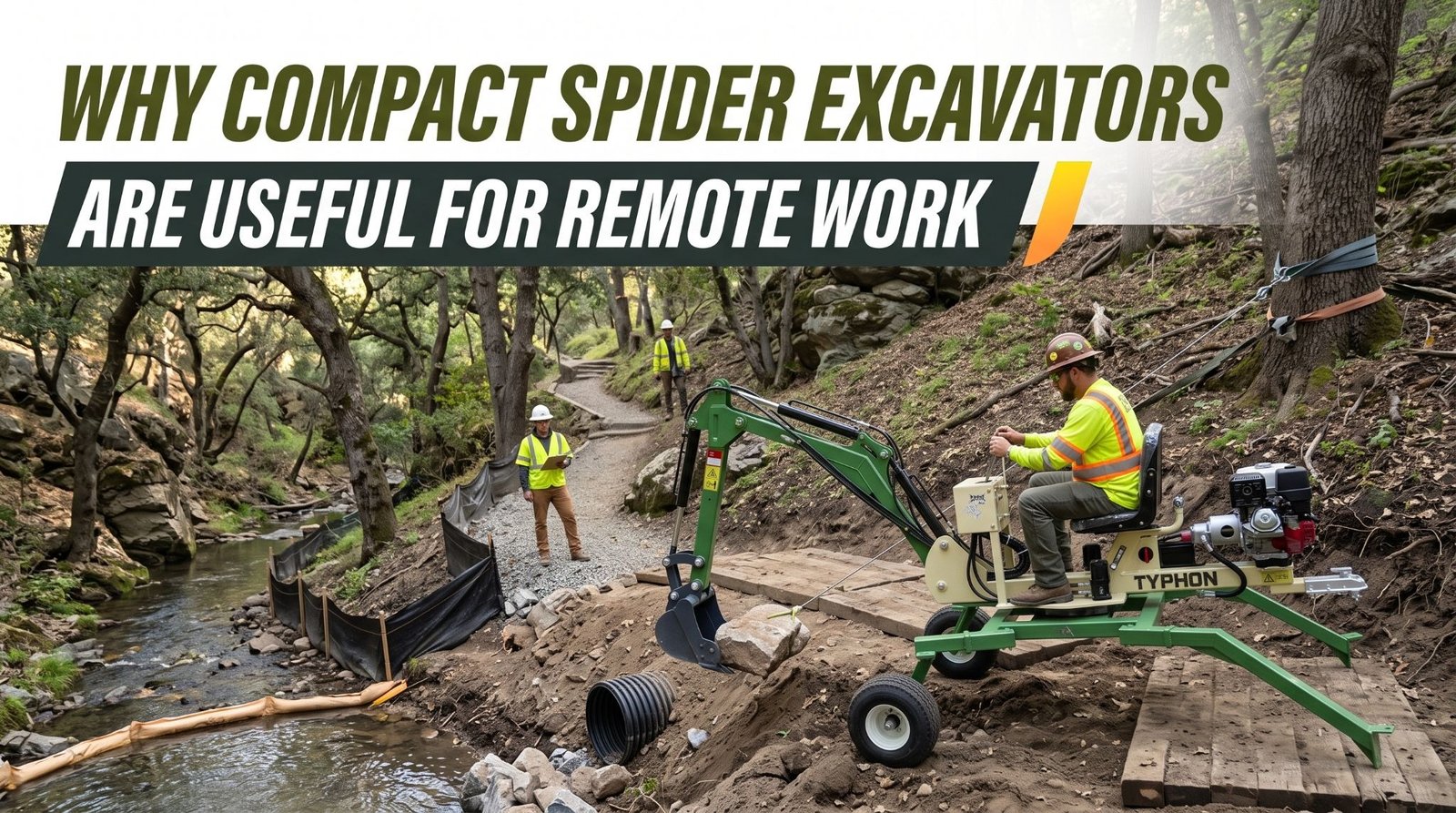
Remote drainage repairs and infrastructure projects often take place on steep slopes, wooded trails, and sites far from established access roads. Conventional excavators may struggle to navigate narrow switchbacks, uneven ground, and restricted entrances, while manual digging can increase labor demands and delay urgent repairs. Compact spider excavators provide an alternative for reaching difficult work areas without extensive site preparation.
Leg configuration, ground contact, machine balance, and working reach all affect performance on challenging terrain. Spider excavators use independently positioned legs to help establish a stable working position on uneven surfaces, subject to the machine’s operating limits and ground conditions. Attachments such as narrow buckets, ditch-cleaning buckets, and hydraulic thumbs allow operators to excavate, shape slopes, and position materials using one machine.
Successful remote operations depend on careful route assessment, suitable equipment selection, and a clear plan for transportation and recovery. Crews should verify access widths, evaluate ground stability, protect nearby vegetation and waterways, and follow the manufacturer’s limits for slope operation and machine positioning. Planning these details before mobilization can reduce unnecessary site disturbance, improve work efficiency, and help keep drainage and utility projects on schedule.
Access Difficult Working Areas
On many remote jobs, the first challenge is getting a machine to the excavation site. Narrow paths, restricted entrances, and confined work zones can prevent larger machines from reaching the work area. When equipment cannot get close enough to the excavation, crews may have to rely on hand digging, work from a distant position with the boom fully extended, or make costly changes to the site.
A compact design gives contractors more options. Smaller overall dimensions allow a spider excavator to travel along narrow routes, pass through restricted openings, and position itself closer to the excavation. On many models, the legs can be retracted for travel to reduce the machine’s width, then spread at the work area to improve stability. This combination helps the machine fit through tight access points while providing a suitable working position once it arrives.
Working closer to the excavation improves control and visibility. The operator can make more precise bucket movements and maintain a clearer view of the digging area and nearby features. Keeping the work within a suitable reach can also improve stability because extending the boom moves the load farther from the machine and reduces its stability margin. Positioning closer to the excavation may also reduce the amount of surrounding ground that needs to be cleared for equipment setup.
Confined areas benefit particularly from this flexibility. Spaces between trees, rock outcrops, retaining walls, and existing structures often leave little room for conventional equipment. A compact spider excavator gives the operator more options for positioning its legs, wheels, or tracks according to the available space and ground conditions.
Access must be confirmed before mobilization. Measure the narrowest point along the entire route, not just the entrance. Gaps between trees, gates, rock features, bridge rails, and retaining walls may be tighter than the main path. Account for the machine’s travel width with its legs retracted, as well as any attachment that extends beyond the machine. Check overhead clearance around low branches, power lines, and structures, and allow extra room at bends where the machine must turn. Bridges, culverts, and boardwalks must also be suitable for the machine’s weight, or the route should avoid them.
Safety begins with a thorough route assessment. Walk an unfamiliar path on foot before moving the machine through it. Use a trained spotter at narrow passages, steep sections, and blind turns, and agree on hand signals or radio communication before travel begins. Keep everyone clear of the machine’s travel path and the movement range of its legs and boom.
Key Takeaway: A compact spider excavator can access narrow paths, restricted entrances, and confined work zones that may be unsuitable for larger machines. Measure the entire route and position the machine as close to the excavation as ground conditions safely allow.
Work Around Uneven Terrain
Remote sites rarely provide flat, prepared ground. Slopes, ditches, rocks, stream banks, and sudden changes in elevation are common. A conventional excavator relies on a fixed undercarriage and generally needs a suitable working surface to maintain stability. On broken terrain, preparing that surface may require significant earthwork before excavation can begin.
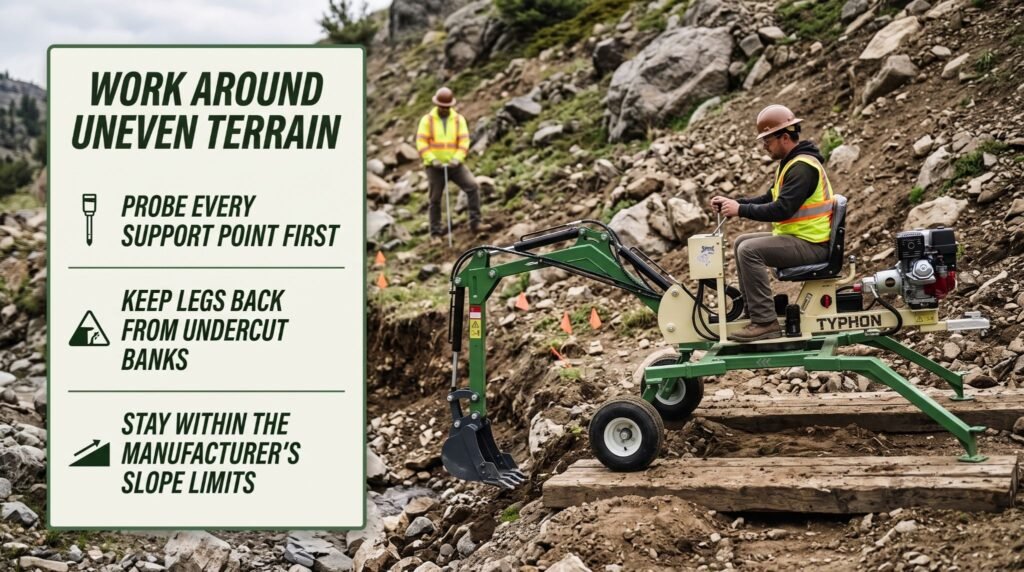
A spider-style excavator is designed to work across more varied terrain. Its legs can typically be adjusted individually, allowing the operator to position the machine on uneven or sloping ground while keeping the upper structure closer to level. Depending on the model, a leg may also be raised to step over a log or rock, reach across a ditch, or place a support on a suitable ledge. Leg designs vary and may include wheels, claws, pads, or a combination of support types. Some models also use tracks or telescoping legs to provide additional positioning options.
This flexibility does not eliminate the need for careful ground assessment. A spider excavator is only as stable as the ground beneath its support points. Soft soil, loose rock, saturated ground, thawing surfaces, and undercut banks can fail under load. Before setting up, assess the slope against the manufacturer’s limits for the machine’s configuration, check each support point for soft spots or hidden voids, and identify areas of recent fill. Pay particular attention to moisture near streams, springs, and drainage outlets, where saturated soil may lose strength quickly. Keep supports away from unstable banks, trench edges, and drop-offs, and check for loose rocks or debris that could fall onto the machine or crew.
Setup technique is just as important as site assessment. Distribute the machine’s weight across the support points as directed by the manufacturer, and use suitable timber mats or pads when additional ground support is needed. Level the upper structure according to the operator’s manual and recheck it whenever the machine is repositioned. Learn how the machine’s inclination indicators and warning systems work, and never ignore or override a stability warning.
Operating technique helps maintain stability on slopes. Wear the seat belt whenever operating a machine fitted with one, and use the protective structure as intended. Make smooth, controlled boom and swing movements, and avoid swinging loaded buckets toward the downhill side whenever possible. Keep loads close to the machine and low during movement, within the manufacturer’s operating guidance. Place spoil where it will not overload the slope or slide back into the work area.
Ground conditions can change throughout a project. Reassess the site after rain, freeze-thaw cycles, or relocation to a new working position. If a leg begins to sink, the machine shifts unexpectedly, or cracks appear near a support point, stop work, lower the bucket to the ground if safe, and reassess the setup before continuing.
Key Takeaway: Spider-style excavators can be positioned on uneven terrain, but safe operation depends on stable support points, correct setup, and compliance with the manufacturer’s slope and stability limits.
Support Utility and Infrastructure Projects
Remote excavation often supports essential infrastructure. Drainage repairs, pipeline maintenance, utility installation, slope stabilization, and work around existing structures may take place in locations that are difficult to reach. These projects still require reliable digging and material handling, even when access and working space are limited.
A compact spider excavator can support a range of tasks without requiring the access routes needed by larger equipment. It can excavate around culverts, outfalls, and drainage structures, then help clean or reshape channels. Along hillsides and wooded corridors, it can open trenches for electrical, communication, and water lines. Where pipelines need inspection, repair, or replacement, the machine may help expose sections for access. It can also assist with slope stabilization by regrading eroded ground, placing riprap, and preparing areas for retaining structures or erosion control. Other applications include maintenance around bridge abutments, retaining walls, towers, and similar structures on steep or confined sites.
Its ability to work from carefully adjusted positions makes it particularly useful on embankments and in ravines, where a conventional excavator might require a large constructed pad before digging can begin.
Working near existing infrastructure requires careful planning. Remote areas may have incomplete or outdated utility records, so drawings alone should not be treated as confirmation of underground line locations. In the United States, contact the local one-call utility locating service by calling 811 before excavation. Wait for the required notification period and confirm that all relevant utility owners have responded. Public locating services generally do not mark every private line, including park lighting, irrigation systems, and service lines to remote buildings. Ask the property owner for available records and arrange for a private locator when needed. Within marked tolerance zones, expose utilities using careful hand digging, vacuum excavation, or another approved method before using mechanical equipment.
Precise machine control can help limit disturbance around sensitive features, but it does not replace proper planning or utility protection. Careful bucket movements and suitable machine positioning help protect both the infrastructure being serviced and the surrounding ground.
Key Takeaway: Compact spider excavators can support drainage, pipeline, utility, slope, and infrastructure projects in difficult-to-access locations. Locate and mark underground utilities, assess nearby structures, and identify overhead hazards before excavation begins.
Handle Different Excavation Tasks
Remote projects rarely involve just one type of work. A single job may require excavation, trenching, backfilling, grading, material placement, and general site preparation. Bringing a separate machine into a difficult location for every task can be expensive, time-consuming, or impractical.
A compact spider excavator can support several tasks when equipped with suitable attachments and configured for the work. General digging buckets handle excavation around pipes, culverts, foundations, and drainage structures. Narrow trenching buckets create defined channels for utility lines and drainpipes, while ditch-cleaning and grading buckets help shape slopes, channels, and finished surfaces. Hydraulic thumbs and grapples can assist with picking and placing rocks, riprap, logs, and debris. Hydraulic breakers may be suitable for fracturing rock or old concrete when approved for the machine. Augers and other specialized tools can support post foundations, anchors, and similar work when the machine’s hydraulic capabilities are sufficient.
Follow the manufacturer’s procedure whenever changing attachments. Park on suitable ground, position the machine safely, and lower the boom as directed. Clean mud and debris from the coupler and mounting points because packed material can prevent the locking mechanism from engaging fully. Confirm that the attachment is securely locked before lifting a load. For hydraulic attachments, relieve system pressure according to the manual before connecting or disconnecting couplers, and keep connection points clean.
Operating technique must suit both the attachment and the ground conditions. Breaking rock or lifting heavy stone on a slope places different demands on the machine than digging ordinary soil. Keep loads within rated limits, avoid sudden movements, and monitor the machine’s stability throughout the task.
Key Takeaway: Suitable attachments allow a compact spider excavator to support excavation, trenching, backfilling, grading, and material placement on a single remote project. Plan attachment compatibility, transport, storage, and safe changes before mobilization.
Plan Transportation and Recovery
Compact equipment still requires careful transportation and recovery planning. Although a spider excavator may reach areas that larger machines cannot, it must still be transported to the site, unloaded safely, moved along the access route, and recovered when the job is complete. Delays often occur during these transitions, particularly when the unloading area is unsuitable, the route is difficult, or weather conditions change.
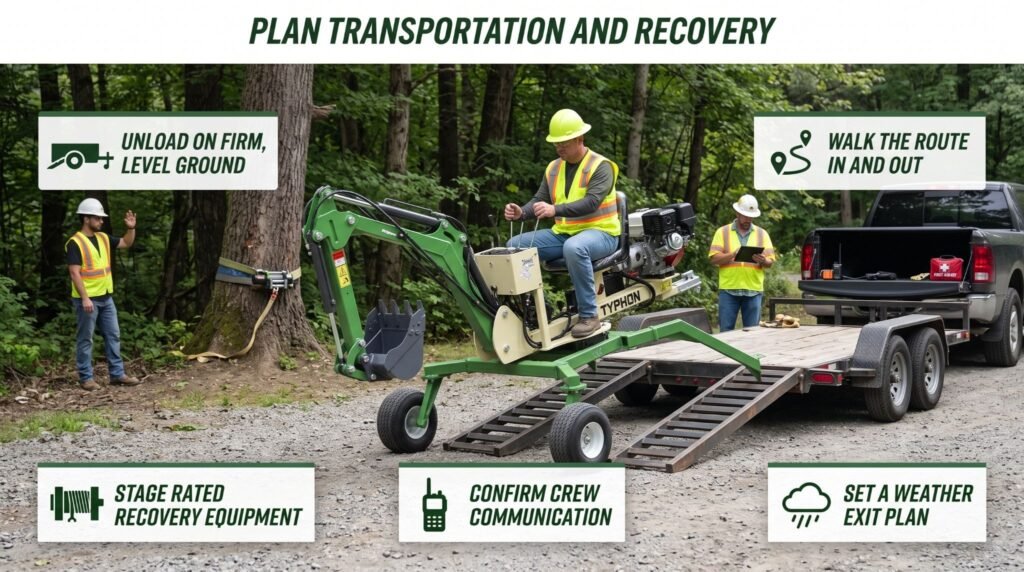
Before transporting the machine, confirm its transport weight and dimensions against the trailer, tow vehicle, and any road restrictions along the route. Secure the excavator using the manufacturer’s designated tie-down points and applicable cargo securement requirements. Retract or fold the legs and position the boom according to the transport instructions in the operator’s manual.
Choose a suitable unloading area before arriving. The location should be firm, level, and large enough for the transport vehicle, excavator, and crew to work safely away from traffic. Avoid soft shoulders, slopes, and areas with overhead hazards. Use a spotter during loading and unloading, and keep everyone clear of the ramps and the machine’s travel path.
Inspect the entire route from the unloading area to the work zone. Check its width, slope, surface conditions, and obstacles, including rocks, roots, logs, and water crossings. Identify sections where the machine may need to adjust its legs, where ground protection mats are necessary, and where a spotter will be required. Follow the manufacturer’s guidance for traveling on slopes, including the permitted direction of travel and leg configuration.
Recovery planning is just as important as site access planning, especially when weather can change ground conditions unexpectedly. Preparing recovery equipment, assigning responsibilities, and establishing emergency procedures help crews respond safely when machinery becomes stuck or an incident occurs.
- Recovery Equipment: Identify suitable equipment, such as a winch, recovery vehicle, or lifting equipment, before work begins. Confirm that all equipment and rigging are rated for the intended operation and suitable for the machine and ground conditions.
- Weather and Ground Conditions: Monitor rain, snow, and freeze-thaw conditions that may weaken the ground or reduce traction. Establish weather thresholds for leaving the site early and reassess travel routes when conditions change.
- Recovery Responsibilities: Assign trained personnel to direct recovery operations and establish clear communication methods. Use suitable radios or other communication systems when mobile coverage is limited.
- Safe Recovery Procedures: Use approved anchor points, rated straps, and suitable rigging. Keep everyone clear of tensioned cables and straps, and never use improvised or unrated equipment for recovery.
- Emergency Preparedness: Keep a first aid kit and fire extinguisher available, identify emergency access points, and share the site location with someone off site. Ensure every crew member knows the evacuation route and how to communicate during an emergency.
Walk the full route before mobilization and reassess it before the machine leaves the site. A recovery plan prepared in advance helps crews respond to changing conditions without leaving equipment stranded or exposing workers to unnecessary risk.
Key Takeaway: Plan transportation, unloading, site access, and recovery before mobilization. Assess route width, slopes, ground conditions, weather, and available recovery equipment to reduce delays and keep the excavator and crew safe.
Conclusion
Compact spider excavators provide practical access to remote and restricted work areas where conventional equipment may struggle to reach. Their compact dimensions suit narrow paths and confined sites, while individually adjustable legs support positioning on uneven terrain within the manufacturer’s operating limits. These machines handle drainage, pipeline installation, utility work, slope maintenance, and infrastructure repairs while potentially reducing access preparation and disturbance to surrounding land. Compatible attachments can support digging, trenching, backfilling, grading, and material placement across different project stages. Before mobilization, contractors should measure the entire access route, check bridge and culvert weight limits, confirm a firm unloading area, and assess slopes and surface conditions in both directions. Ground stability should be evaluated at planned working positions and support points, while public and private utilities, pipelines, cables, overhead lines, and nearby structures must be identified. Permits, erosion controls, restoration requirements, attachment compatibility, and hydraulic connections should also be confirmed before work begins. Recovery equipment, suitable anchor points, crew communication methods, emergency access, and a weather-based exit plan should be arranged in advance. Reviewing the manufacturer’s slope limits and operating guidance with every operator helps maintain controlled operation on challenging terrain. Careful planning of access, ground conditions, attachments, utilities, and recovery procedures supports dependable excavation while protecting surrounding land and infrastructure.
Frequently Asked Questions
What is a spider excavator used for?
Spider excavators handle excavation and material-moving tasks where limited access, steep slopes, or uneven terrain restrict conventional equipment. Common applications include drainage repairs, utility installation, pipeline work, slope stabilization, and infrastructure maintenance. With suitable attachments, they can also trench, backfill, grade, and place rock. Contractors often choose them when access for larger equipment would require costly or disruptive site preparation.
Are compact excavators suitable for remote jobsites?
Yes. Compact excavators, including spider-style models, can reach some remote work areas through narrow routes that larger machines can’t use, which may reduce the need for access roads and extensive site preparation. Before mobilizing, measure the route, confirm a suitable unloading area, assess ground conditions, and plan for weather changes, recovery, and the attachments each project stage requires.
Can a compact excavator work on uneven terrain?
Some compact excavators are designed for uneven terrain, but operators must assess ground stability, slope, and machine limits before working. Spider excavators can typically adjust their legs individually to position the machine on slopes and broken ground. Soft soil, loose rock, saturated ground, and undercut banks can still create hazards, so inspect every support point and follow the manufacturer’s slope and stability limits.
What projects can use a spider excavator?
Spider excavators suit utility installation, drainage and culvert repairs, slope stabilization, pipeline work, infrastructure maintenance, and excavation in restricted locations such as hillsides, wooded areas, and confined urban sites. Suitability depends on terrain, access, digging requirements, and available attachments. Matching these factors to the manufacturer’s operating limits helps you select the right machine and complete the work efficiently.