

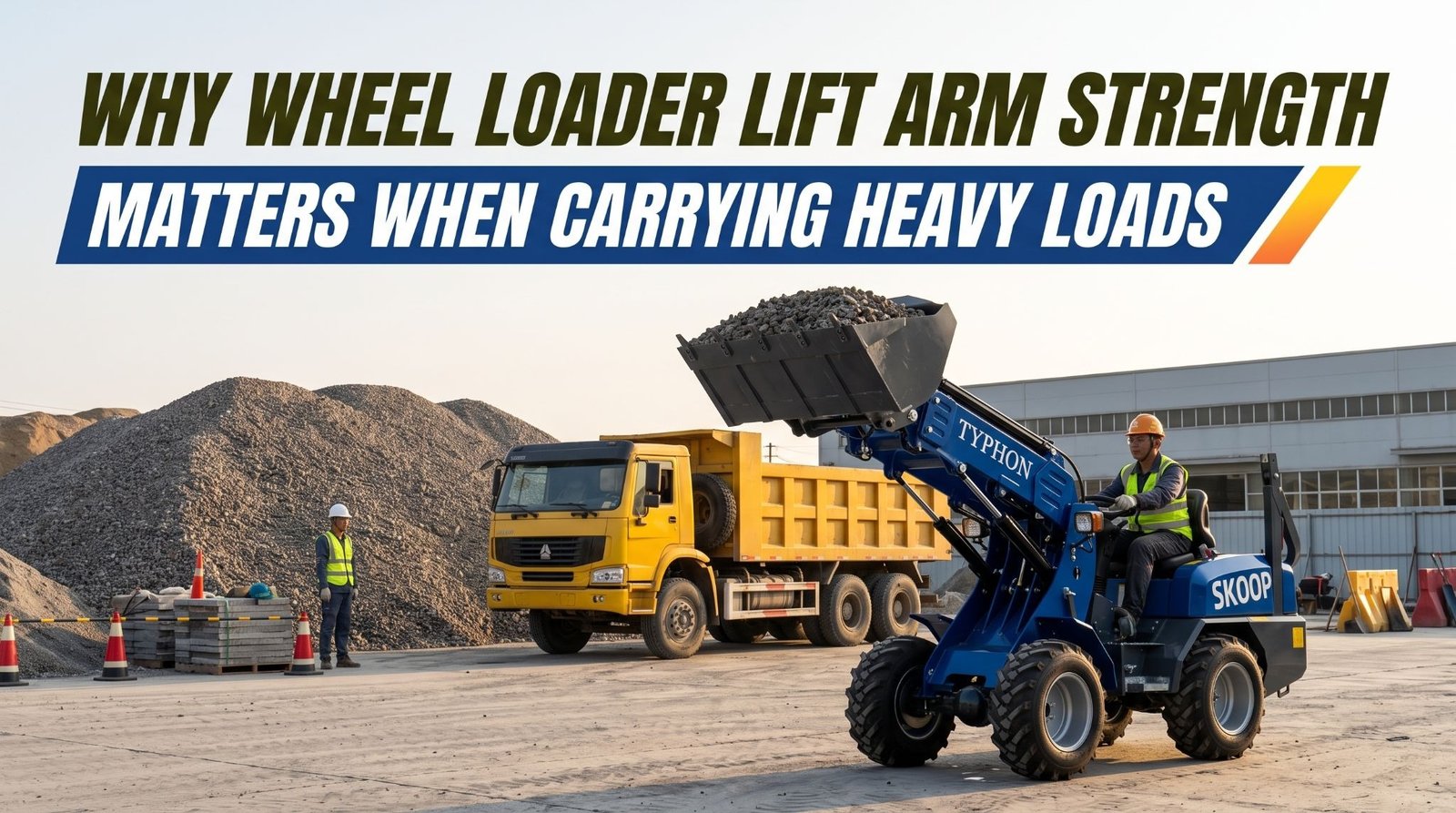
Why Wheel Loader Lift Arm Strength Matters When Carrying Heavy Loads
Ask any operator what makes a wheel loader dependable, and the answer usually comes back to power and capacity. Yet beneath those headline figures sits a quieter, more fundamental truth: the machine can only carry what its lift arms can hold. Those arms are the working backbone of every loader, the structure that turns hydraulic power into real, controlled movement of heavy material. When they are strong and thoughtfully built, the machine works hard, holds loads steadily, and keeps doing so for years. When they fall short, the whole machine falls short with them. This guide takes a close look at why lift-arm strength matters so much, how the arms partner with the hydraulic system, how they shape stability, why they must endure relentless repetition, and what to weigh when choosing a loader built to carry heavy loads with confidence.
How Lift Arms Support Heavy Loads
The lift arms sit at the center of everything a wheel loader does with material. They carry and raise the attachment along with its payload, so every full bucket of aggregate, every raised pallet, and every load lifted into a truck bed passes directly through them. That role makes their strength essential to the machine’s lifting performance. Power from the engine and force from the hydraulics only matter if the arms can bear the weight and hold their shape while moving it. In practical terms, the arms are where lifting is either delivered or lost, which is why their design deserves as much attention as any other specification on the machine.
A robust lift-arm design is what gives a loader the confidence to take on demanding loading and material-handling tasks. Heavy material puts real stress on the arm structure, and well-engineered arms carry that stress without excessive flex, bending, or loss of precision. That solid construction is what separates a machine that works within its rating comfortably from one that strains at the edge of its limits. Consider where strong arms prove their worth in daily operation:
- Dense, heavy material such as wet soil, gravel, and rock, where a full bucket pushes toward the top of the machine’s capacity.
- Lifting to height, raising material into trucks, hoppers, and elevated positions while keeping the load controlled through the full arc.
- Heavy attachments, supporting forks, grapples, and specialized tools together with the payload they carry.
In each of these tasks, the arms do the demanding structural work of holding and moving weight. Strong arms deliver that performance load after load, letting the operator use the machine’s full capability rather than easing off to protect an underbuilt frame. This is the heart of why lift-arm strength is a genuine measure of a loader’s real-world capacity. A machine built with robust arms handles heavy material reliably; one built lighter will show its limits the moment the work gets serious.
Lift Arm Strength and Hydraulic Force
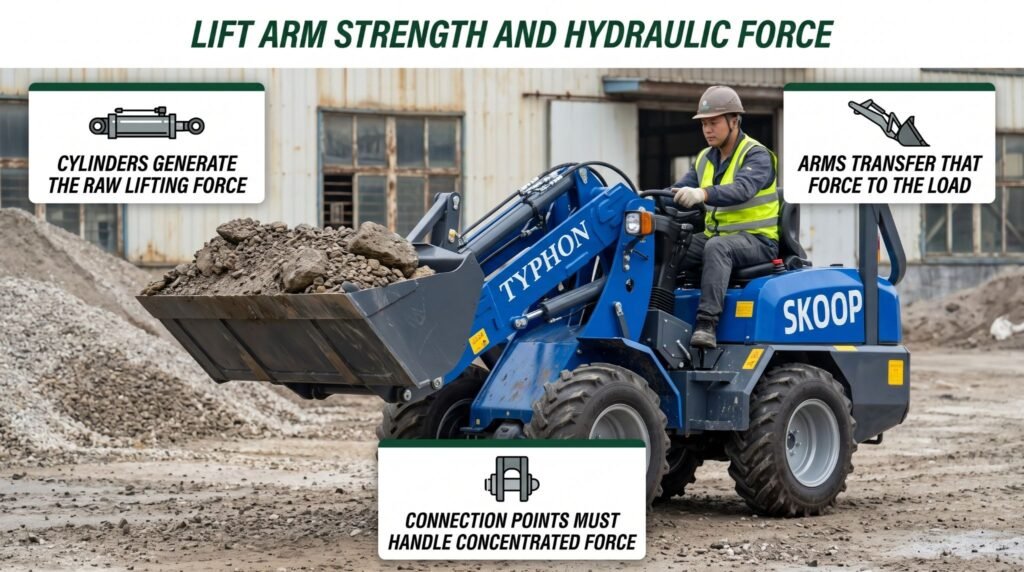
Lift arms never carry a load alone. They work in close partnership with the hydraulic cylinders that generate the lifting force, and grasping this relationship is key to understanding lifting performance as a whole. The hydraulic system supplies the power, driving the cylinders that raise and lower the arms, while the arms themselves transfer that force to the attachment and payload. Both halves of the partnership have to be equal to the task. Strong arms paired with weak hydraulics cannot lift heavy loads, and powerful hydraulics paired with weak arms cannot deliver that power safely or precisely. The two are meant to match, and a well-built loader is engineered so they do.
The hydraulic system’s responsibility is to provide enough force to raise the load through its entire range of motion. When a bucket fills with heavy material, the cylinders must generate the pressure to break that load free and lift it steadily upward without straining or stalling. This calls for a hydraulic system sized to the machine’s intended work, capable of producing the force that demanding loads require. The more capable the hydraulics, the more the machine can lift, but only if the structure carrying that force is built to keep pace.
That is exactly where the lift arms earn their place, because they must transfer hydraulic force efficiently and without waste. Here is how the partnership functions in practice:
- The hydraulic cylinders generate the raw lifting force, converting hydraulic pressure into the mechanical movement that raises the arms.
- The lift arms carry that force to the load, translating the cylinders’ power into steady, controlled lifting of the attachment and payload.
- The connection points where cylinders meet arms must be robust enough to handle the concentrated forces passing through them.
When arms and hydraulics are properly matched, force flows cleanly from the cylinders through the arms to the load, producing strong, controlled lifting. Well-designed arms pass that force along without flexing or absorbing it wastefully, so the power the hydraulics generate reaches the payload where it counts. This coordinated performance is what gives a capable wheel loader its dependable lifting strength, and it is why the arms and hydraulics should always be considered together rather than in isolation.
Impact on Load Stability
Strength is not only about how much a machine can raise; it is also about how well it holds what it lifts. Here, strong and properly designed lift arms make a decisive difference. When a loader carries heavy material, well-built arms hold that load steadily instead of flexing or wavering, giving the operator precise control through lifting, carrying, and placing. Rigid, correctly engineered arms keep the load where the operator sets it, which matters enormously when material is moved near people, structures, or other equipment. Control and stability are inseparable, and both rest on arms that hold a load without compromise.
Even so, the arms are only one part of the stability picture. Several characteristics of the machine work together to keep it steady under load, and each deserves attention. Consider the factors that shape stability during both lifting and travel:
- Loader geometry, the design and proportions of the arms, linkage, and machine, which govern how loads are carried and how forces are distributed.
- Operating weight, the mass of the machine itself, which anchors it and counterbalances the load carried out front.
- Load position, how high and how far forward the load sits, since a raised or extended load shifts the machine’s balance far more than a low, close one.
These elements interact continuously as the machine works. A loader’s geometry is engineered to carry loads in a balanced, predictable way, while its operating weight provides the counterbalance that keeps the machine grounded when weight is held at the front. Load position then changes moment to moment; a load kept low and close keeps the machine most stable, while raising or reaching out demands more from its balance. When strong lift arms combine with sound geometry, adequate operating weight, and sensible load handling, the loader stays stable and controlled through every stage of the work. That combination is what lets an operator carry heavy material with genuine confidence rather than constant caution.
Durability Under Repeated Loading
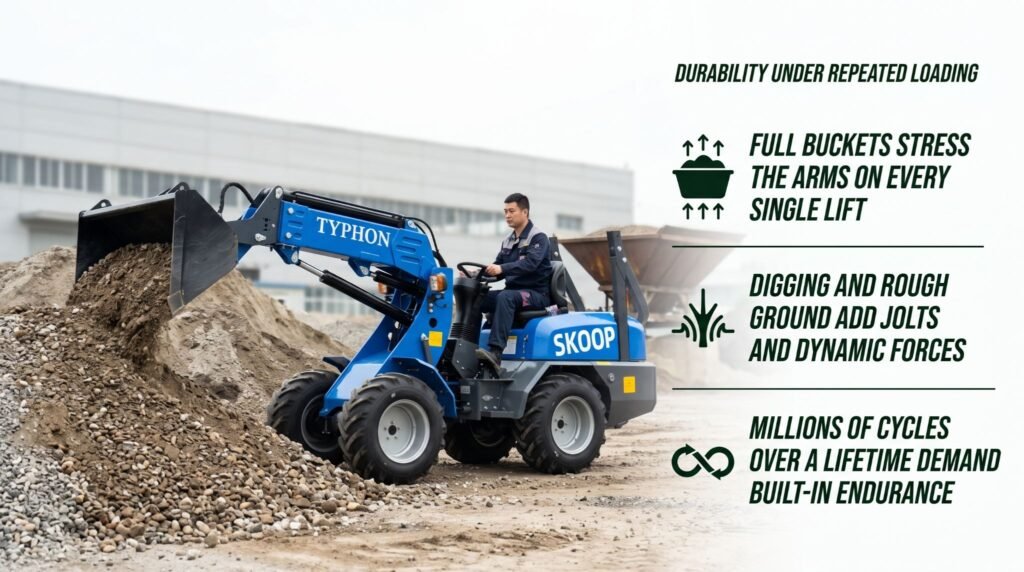
A wheel loader almost never lifts just once. It works in cycles, repeating the same demanding sequence throughout the shift: scooping material, lifting it, carrying it, and dumping it, then returning to start again. Each cycle places substantial load and stress on the lift arms, and across a single day those cycles run into the hundreds. Over the machine’s full service life, they climb into the millions. This constant repetition is precisely what makes durability such a critical quality in lift-arm design, because the arms must withstand not one heavy lift but a working lifetime of them.
The stresses involved are both heavy and varied. Scooping drives the arms and attachment into resistant material, lifting loads them with the full weight of the payload, carrying subjects them to the forces of travel and movement, and dumping brings its own shifts as material leaves the bucket. Consider what the arms must endure across every cycle:
- Repeated heavy loading, as full buckets and payloads stress the arms on each and every lift.
- Dynamic forces, the jolts, shifts, and impacts that come from digging into material and traveling across uneven ground.
- Constant cycling, the sheer number of repetitions that would fatigue any structure not built to endure them.
Arms that are not built for this repetition will eventually reveal it, developing wear, fatigue, or failure that pulls the machine out of service at the worst possible time. Well-engineered lift arms, by contrast, are designed to absorb these repeated loads and stresses reliably, holding their strength and precision through years of hard use. Robust construction, quality materials, and sound engineering come together to produce arms that keep performing cycle after cycle. This durability is the foundation of dependable long-term operation, because a machine that keeps working protects both your productivity and your investment. For any operation that runs a loader hard, arms built to withstand repeated loading are not a luxury but a requirement for keeping the work moving and downtime low.
Matching Lift Capacity to the Job
Lift-arm strength is vital, but it is one piece of a wheel loader’s overall lifting capability rather than the whole of it. Choosing the right machine means looking past the arms alone to the full combination of factors that determine how well a loader handles your work. A machine with strong arms but insufficient hydraulic force, too little operating weight, or a rating below your real needs will not deliver the performance the job demands. The sound approach is to weigh several specifications together, matching the complete machine to the materials you handle and the tasks you perform.
Begin with the factors that most directly define lifting capability. Weigh these together when evaluating a wheel loader:
- Rated load capacity, the amount the machine is designed to lift and carry safely, which should comfortably exceed the loads your work involves.
- Hydraulic performance, the force the system delivers to raise loads, which must meet the demands of heavy material and elevated lifting.
- Attachment weight, since buckets, forks, and grapples count against the machine’s capacity and reduce the payload that remains.
- Operating weight, which anchors the machine for stable lifting and carrying and shapes how it behaves under load.
- Material type, because dense, heavy materials such as wet soil and rock place far greater demands on the machine than light, loose ones.
These factors are interconnected, so a sound choice balances them against your real requirements instead of chasing any single number. A loader well matched to your work will carry the loads you handle, lift them with strength to spare, stay stable throughout, and do so with attachments suited to the task. Judging capacity by rated load alone, without accounting for hydraulics, weight, attachments, and material, invites a mismatch that shows up as strain and shortfall on the job.
The dependable method is to define the heaviest and most frequent loads you handle, the materials involved, and the attachments you rely on, then choose a wheel loader whose rated capacity, hydraulic performance, and operating weight comfortably meet those needs. Matching the complete machine to the work this way ensures the loader delivers reliable, confident lifting, with lift arms strong enough to carry heavy loads as a core part of a well-balanced whole.
Conclusion
Lift-arm strength stands at the center of a wheel loader’s ability to carry heavy loads. The arms bear and raise every attachment and payload, which makes their strength essential to lifting performance, and a robust design is what lets a loader take on demanding material-handling work with confidence. That strength works in close partnership with the hydraulic system, the cylinders generating force while the arms transfer it cleanly and efficiently to the load. Strong, well-designed arms also protect stability, holding heavy material under control, while loader geometry, operating weight, and load position all contribute to a steady, balanced machine. Because loaders work in constant scoop-lift-carry-dump cycles, the arms must withstand repeated loads and stresses to deliver reliable long-term operation. Still, lift-arm strength is one part of a larger whole, so choosing well means weighing rated load capacity, hydraulic performance, attachment weight, operating weight, and material type together. Match the complete machine to your work, and a wheel loader with strong lift arms will carry heavy loads dependably, shift after shift, year after year.
Frequently Asked Questions
1. Why are lift arms so important to a wheel loader’s performance?
The lift arms are the structural link between the loader and its work, carrying and raising the attachment along with whatever payload it holds. Every full bucket lifted or heavy pallet raised passes through them, so their strength is central to the machine’s entire lifting performance. A loader may have plenty of engine power and a capable hydraulic system, but if the arms cannot handle the loads placed on them, that capability never reaches the ground. Robust arms allow the machine to handle dense material such as wet soil and rock, lift loads to height into trucks and hoppers, and carry heavy attachments like forks and grapples along with their payloads. Strong arms deliver this consistently, letting the operator work at the machine’s full capability rather than holding back to protect an underbuilt structure. That is why arm strength is a true measure of a loader’s real-world capacity.
2. How do lift arms work together with the hydraulic system?
Lift arms and hydraulics function as a matched partnership. The hydraulic system supplies the power, driving the cylinders that raise and lower the arms, while the arms transfer that force to the attachment and payload. Both parts must be equal to the task, since strong arms with weak hydraulics cannot lift heavy loads, and powerful hydraulics with weak arms cannot deliver that power safely. The hydraulic system must provide enough force to raise the load through its full range of motion, breaking a heavy bucket free of the ground and lifting it steadily. The arms then carry that force to the load, translating the cylinders’ power into controlled lifting, while the connection points where cylinders meet arms must be robust enough for the concentrated forces passing through. When arms and hydraulics are properly matched, force flows cleanly from cylinders through arms to load, producing strong, controlled lifting.
3. How do lift arms affect load stability?
Strong, properly designed lift arms help maintain control when carrying heavy materials, holding the load steadily instead of flexing or wavering. This gives the operator precise control through lifting, carrying, and placing, which matters greatly when working near people, structures, or equipment. The arms, however, are only one part of stability. Loader geometry, the design and proportions of the arms and linkage, determines how loads are carried and how forces are distributed. Operating weight anchors the machine and counterbalances the load held out front. Load position matters too, since a load kept low and close keeps the machine most stable, while raising or extending it shifts the balance further. When strong arms combine with sound geometry, adequate operating weight, and sensible load handling, the loader stays stable and controlled through lifting and travel, letting the operator work with confidence rather than caution.
4. Why does durability matter so much for lift arms?
Wheel loaders work in constant cycles, repeating the same scoop-lift-carry-dump sequence again and again. Across a working day these cycles number in the hundreds, and over the machine’s service life they reach into the millions, so the arms must withstand not a single heavy lift but a lifetime of them. The stresses are heavy and varied: scooping drives the arms into resistant material, lifting loads them with the full payload weight, carrying subjects them to travel forces, and dumping brings its own shifts in load. The arms face repeated heavy loading on every lift, dynamic forces from digging and uneven ground, and the constant cycling that would fatigue any structure not built to endure it. Arms not built for this develop wear, fatigue, or failure that pulls the machine from service, while well-engineered arms absorb these stresses reliably, underpinning dependable long-term operation and protecting your productivity and investment.
5. What should I consider when choosing a wheel loader for heavy lifting?
Lift-arm strength is vital, but it is only one part of overall lifting capability, so weigh several factors together rather than fixating on a single figure. Rated load capacity is the amount the machine is designed to lift and carry safely, and it should comfortably exceed the loads your work involves. Hydraulic performance is the force the system delivers to raise loads, which must meet the demands of heavy material and elevated lifting. Attachment weight matters because buckets, forks, and grapples count against capacity and reduce the payload that remains. Operating weight anchors the machine for stable lifting and shapes how it performs under load. Material type is important too, since dense materials such as wet soil and rock place far greater demands than light, loose ones. Define your heaviest and most frequent loads, the materials involved, and the attachments you rely on, then choose a machine whose capacity, hydraulics, and weight comfortably meet those needs.