

Lithium-Ion Forklift ROI Calculator: Maximize Your Returns
Effectively managing warehouse operations requires informed, data-driven decision-making. Every investment—especially in material handling equipment—demands careful evaluation, as these assets impact daily productivity, operational safety, and long-term profitability. In today’s highly competitive logistics sector, upgrading your forklift fleet from lead-acid batteries to lithium-ion power is not just a matter of following trends; it’s a strategic move with far-reaching financial and operational implications.
With advancements in battery technology, facility managers have the opportunity to unlock superior performance, reduce costly downtime, and improve workplace safety. However, these potential benefits must be carefully weighed against the upfront expense of adopting lithium-ion technology. This is where a robust return on investment (ROI) calculation becomes indispensable. Understanding your ROI enables you to justify capital outlays to stakeholders, set realistic budget expectations, and ensure your business maximizes value from every dollar invested.
Transitioning your fleet is a significant operational upgrade, but it requires a comprehensive look at the numbers—considering both immediate costs and the total cost of ownership. By taking a disciplined approach to ROI analysis, you can clearly identify how lithium-ion forklifts benefit your operation now and for years to come.
A comprehensive lithium-ion forklift ROI calculator helps you see the complete financial picture. You cannot look at the sticker price alone. You must evaluate the total cost of ownership over the lifespan of the equipment. When you crunch the numbers, the long-term financial benefits of advanced battery technology become incredibly clear.
This guide breaks down exactly how to measure your return on investment. We will explore how to factor in upfront costs, operational savings, maintenance reductions, and massive productivity gains. By the end of this post, you will possess the knowledge needed to calculate your exact savings and make an authoritative decision for your facility.
The True Cost of Forklift Power
To calculate an accurate return on investment, you must establish a detailed baseline that goes beyond surface-level cost comparisons. Begin by examining the total costs of your current lead-acid fleet, including every associated expense over the expected service life of the equipment. This comprehensive view should factor in not only the number and price of batteries required, but also charger equipment, battery storage and handling infrastructure, and the ongoing cost of safety compliance.
For lead-acid systems, anticipate purchasing two to three batteries per forklift if your operation runs multiple shifts—a necessity due to the lengthy charging and cooling cycles required to prevent overheating. Each battery demands a dedicated charging bay, increasing your facility’s energy requirements and consuming valuable square footage. Beyond capital investments, calculate the labor hours your team spends swapping, charging, watering, and maintaining these batteries. Do not underestimate the operational disruption caused by mandatory cooldown periods or unplanned equipment downtime from battery-related issues.
In contrast, a lithium-ion system features a higher initial battery cost, but delivers clear advantages that quickly balance the ledger. Typically, one lithium-ion battery per forklift suffices—even in round-the-clock operations—through efficient, rapid opportunity charging. These batteries do not require special charging rooms, and you can install compact charging stations wherever convenient, further optimizing your warehouse layout.
Moreover, lithium-ion batteries have a substantially longer lifespan—often double or triple that of lead-acid counterparts. This longevity drastically reduces replacement frequency and interruptions to your operational flow. Factoring in reduced utility costs, minimized maintenance-related labor, and the elimination of specialized safety equipment for battery rooms highlights the true picture of ownership. When analyzed holistically, the lifecycle cost of lithium-ion technology often proves lower than lead-acid, especially in demanding, multi-shift environments. By methodically evaluating these factors, your ROI calculation becomes a powerful tool for charting a more efficient and profitable path forward.
Understanding Upfront Costs
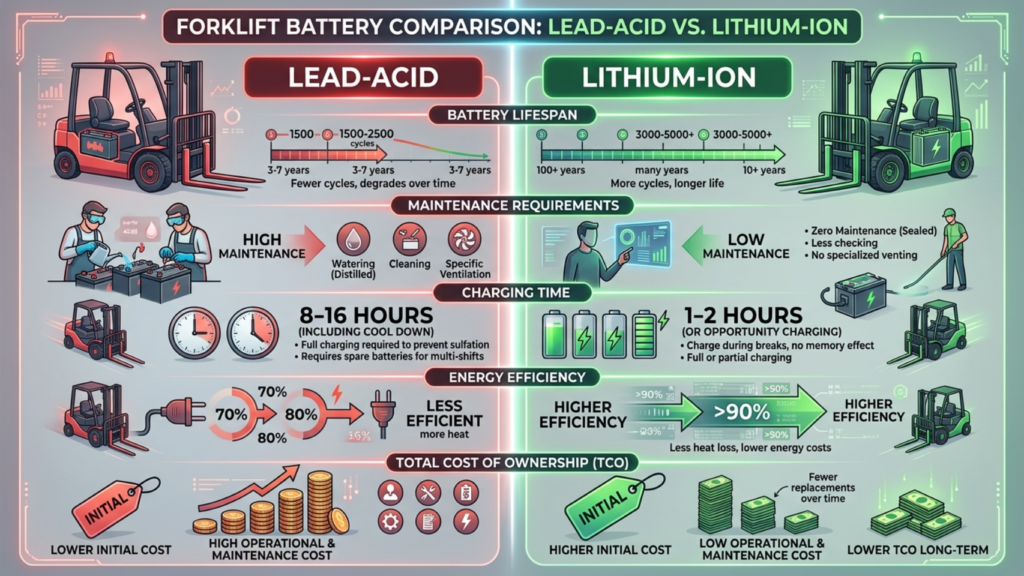
Lithium-ion batteries carry a higher initial purchase price than traditional lead-acid units. A single lithium-ion battery might cost two to three times more than a standard lead-acid battery. For many facility managers, this initial price tag causes hesitation. However, this direct comparison is deeply flawed.
If your warehouse runs multiple shifts, a single lead-acid battery cannot survive the entire day. You must purchase two or even three lead-acid batteries for every single forklift in your fleet. Conversely, a single lithium-ion battery can power a forklift through multiple shifts using strategic opportunity charging. When you calculate the upfront cost of three lead-acid batteries versus one lithium-ion battery, the initial price gap shrinks dramatically.
Factoring in Equipment Lifespan
You must also consider how long your investment will last. A standard lead-acid battery typically delivers between 1,000 and 1,500 charge cycles. If you maintain the battery perfectly, you might get three to five years of usable life.
A premium lithium-ion battery delivers between 2,000 and 3,000 charge cycles. In most operational environments, a lithium-ion unit will last up to ten years. This means you will likely replace your lead-acid batteries two or three times before you need to replace a single lithium-ion battery. Your ROI calculator must account for these future replacement costs.
Key Variables for Your ROI Calculator
The highest returns on a lithium-ion investment come from meaningful operational improvements accumulated day after day. While some benefits are clear-cut, others may be less obvious yet equally impactful as they scale across your entire operation. To build an ROI model you can trust, focus on the following key variables:
1. Upfront and Lifecycle Costs: Go beyond initial battery purchase prices—factor in associated expenses such as the number of batteries required per shift, the cost of chargers and charging infrastructure, and the potential need for HVAC upgrades or fire suppression systems in dedicated battery rooms for lead-acid units. Lithium-ion systems reduce or eliminate many of these expenditures.
2. Energy Efficiency and Utility Savings: Quantify the difference in charging efficiency between battery types. Lithium-ion batteries convert nearly all input power into usable energy and maintain steady performance as charge levels decrease. Lead-acid units, on the other hand, lose a notable portion of energy during charging and become less efficient over time. Calculate projected annualized energy consumption and corresponding reductions in utility costs to accurately reflect the savings.
3. Labor Allocation and Downtime: Carefully track labor hours lost to battery change-outs, maintenance, and unplanned downtime. Lithium-ion batteries allow for fast opportunity charging, minimizing interruptions and maximizing truck availability. Consider the ripple effect: when operators spend less time servicing batteries, they can focus on core tasks that improve throughput and customer service.
4. Maintenance and Repair Requirements: Maintenance costs represent a significant variable. Lead-acid batteries require regular watering, cleaning, and equalizing. In contrast, lithium-ion batteries are virtually maintenance-free. Your ROI calculation should include not just supply and parts costs, but also the labor and potential production interruptions incurred by recurring maintenance events.
5. Equipment Longevity and Replacement Cycles: Extend your analysis to the expected service life of both battery types. Account for the replacement frequency across your fleet. Fewer replacements translate to reduced long-term capital outlays and less operational disruption—a key consideration over multi-year planning horizons.
6. Productivity and Trucks in Service: Evaluate how consistently your fleet operates at peak productivity. Lithium-ion’s rapid charging means more trucks are available to move inventory and fewer are sidelined for extended periods. This increase in uptime directly lifts productivity metrics, reduces backlogs, and helps your operation respond effectively to demand surges.
7. Safety, Compliance, and Claims Reduction: Include the anticipated impact on workplace incidents and compliance requirements. Lithium-ion batteries minimize the risk of acid spills, noxious gases, and heavy manual handling—areas that can result in costly worker compensation claims, regulatory fines, and process interruptions.
By thoroughly measuring the impact of each of these variables and adjusting for your facility’s unique requirements, your ROI calculation will provide a comprehensive, realistic projection of cost savings, risk mitigation, and operational gains achieved through lithium-ion forklift adoption.
Operational Savings and Energy Efficiency
Energy costs consume a massive portion of your operational budget. Traditional lead-acid batteries are notoriously inefficient. As they charge, they generate excess heat, wasting roughly twenty percent of the electricity drawn from the grid. Furthermore, their performance degrades as the battery discharges, forcing the forklift to draw more amps to perform the same amount of work.
Lithium-ion technology is vastly more efficient. These batteries convert over ninety-nine percent of grid power into usable energy. They also maintain a flat voltage curve, meaning the forklift operates at full power even when the battery drops to a ten percent charge. Depending on your local utility rates, this improved energy efficiency can reduce your forklift charging costs by up to thirty percent annually.
Maintenance Reductions
Lead-acid batteries require constant, specialized maintenance. To prevent permanent damage, your team must water the cells regularly. They must clean off acid spills, monitor specific gravity, and perform weekly equalizing charges. This routine maintenance demands significant labor hours.
Lithium-ion batteries require absolutely zero daily maintenance. They are completely sealed units. Your team never needs to add water, clean acid off the casing, or perform equalization processes. When building your ROI calculator, multiply your maintenance team’s hourly wage by the hours they spend servicing lead-acid batteries each week. This entire labor cost vanishes the moment you switch to lithium-ion power.
Productivity Gains and Downtime Elimination
Battery swapping represents one of the largest hidden costs in a multi-shift warehouse. When a lead-acid battery dies mid-shift, the operator must drive to the battery room. They must use heavy extraction equipment to remove the dead battery and install a fresh one. This process typically takes twenty to thirty minutes per shift.
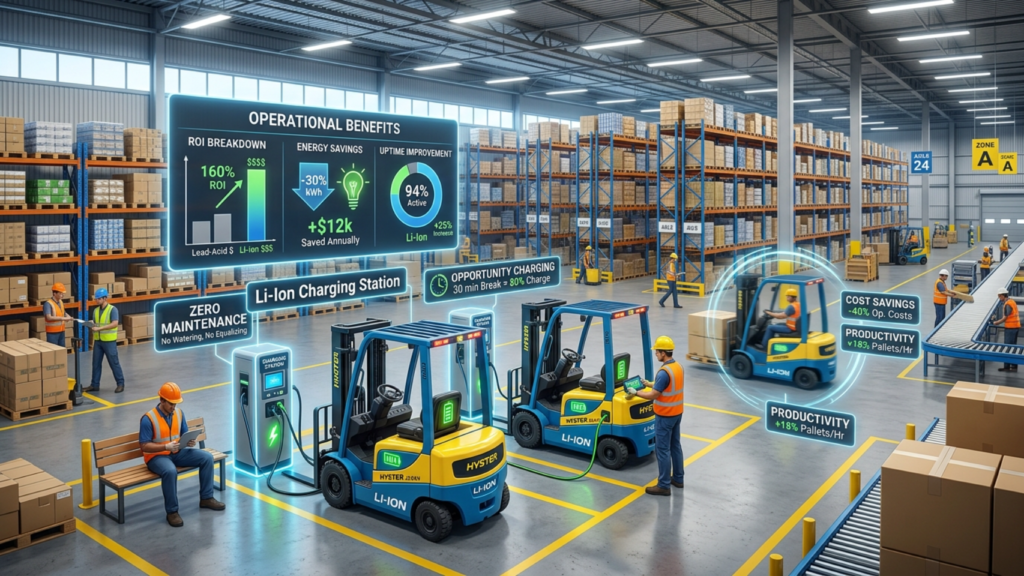
Lithium-ion batteries eliminate the battery room entirely. Operators can plug the forklift directly into a charger during their lunch breaks or standard fifteen-minute shift changes. This practice, known as opportunity charging, keeps the forklift running continuously. By eliminating a daily thirty-minute battery swap, you reclaim dozens of hours of productive labor per operator every single month.
Example Scenario: Calculating Your Return on Investment
Let’s put these calculations into action with a practical example. Imagine your warehouse operates five forklifts across two daily shifts, running 250 workdays per year, with each operator’s fully burdened labor rate set at $25 per hour. Below, we break down the comparative costs and project your overall return on investment over a five-year period.
Fleet Size and Shift Schedule
- Number of forklifts: 5
- Daily shifts: 2 (2-shift operation)
- Workdays per year: 250
- Labor rate: $25/hour
Lead-Acid Battery System Costs
- Number of lead-acid batteries needed: 10 (2 per truck for alternating charging)
- Battery cost: $5,000 each
- Total upfront battery cost: $50,000
- Typical battery lifespan: 3–5 years (likely to replace each battery at least once within 5 years)
Battery Room and Charging Infrastructure:
Estimate $10,000 for dedicated charging equipment and battery-changing equipment (hoists, ventilation, containment).
Total capital investment for lead-acid system: $60,000
Labor for Battery Swaps:
- 5 forklifts x 0.5 hours/day (30 minutes) = 2.5 hours/day
- 2.5 hours/day x 250 days = 625 hours/year
- 625 hours/year x $25/hour = $15,625/year
Maintenance Labor:
- 1 hour/week per truck for watering, cleaning, equalizing
- 1 hour x 5 trucks x 52 weeks = 260 hours/year
- 260 hours/year x $25/hour = $6,500/year
Battery Replacements:
Assume each battery is replaced once within 5 years (for aggressive, multi-shift use):
- 10 additional batteries x $5,000 = $50,000 (years 4–5)
Five-Year Cost Summary (Lead-Acid):
- Initial capital: $60,000
- Battery replacements: $50,000
- Battery swap labor: $15,625 x 5 = $78,125
- Maintenance labor: $6,500 x 5 = $32,500
- Grand Total Over 5 Years: $220,625 (not including energy inefficiency or emergency downtime)
Lithium-Ion Battery System Costs
- Number of lithium-ion batteries required: 5 (one per truck)
- Battery cost: $15,000 each
- Total upfront battery cost: $75,000
- Typical battery lifespan: 8–10 years (no anticipated replacement in first 5 years)
No Battery Room or Hoist Needed:
Opportunity charging allows charging at lunch or breaks—special rooms or equipment aren’t necessary. Most units come with standard charging stations.
- Total initial investment (batteries and chargers): $75,000
Labor Lost on Battery Swaps:
- Swapping is eliminated. Zero hours lost per shift.
Maintenance Labor:
- Lithium-ion batteries are maintenance free. No watering, equalizing, or cleaning. Negligible maintenance labor cost.
Energy Savings:
- Lithium-ion batteries recover 30%–40% of energy costs annually vs. lead-acid due to higher charge efficiency and less heat loss.
- Assume $4,000/year in electricity savings for this fleet ($20,000 over 5 years).
Five-Year Cost Summary (Lithium-Ion):
- Initial capital: $75,000
- Energy savings: subtract $20,000
- Battery replacements: $0
- Battery swap/maintenance labor: $0
- Grand Total Over 5 Years: $55,000 (after subtracting energy savings)
Five-Year Comparative Outcome
| Category | Lead-Acid (5-Year) | Lithium-Ion (5-Year) |
| Upfront Battery/Infra | $60,000 | $75,000 |
| Battery Replacements | $50,000 | $0 |
| Battery Swap Labor | $78,125 | $0 |
| Maintenance Labor | $32,500 | $0 |
| Energy Savings | — | -$20,000 |
| Total 5-Yr Cost | $220,625 | $55,000 |
Net Savings:
By transitioning to lithium-ion, your warehouse saves approximately $165,000 over five years—translating to over $33,000 per year on average, before considering secondary benefits like increased uptime, warehouse space optimization, and improved safety.
Additional Outcome Scenarios:
- If your operation grows (e.g., 10 or 20 forklifts), savings scale directly with fleet size.
- If workloads increase or electricity rates rise, the ROI becomes even more compelling.
- Indirect gains, such as reduced insurance claims from eliminated battery changing, further strengthen the case.
These calculations empower you with concrete data to present to stakeholders, align budget planning, and confidently map the financial justification for switching to lithium-ion forklift power.
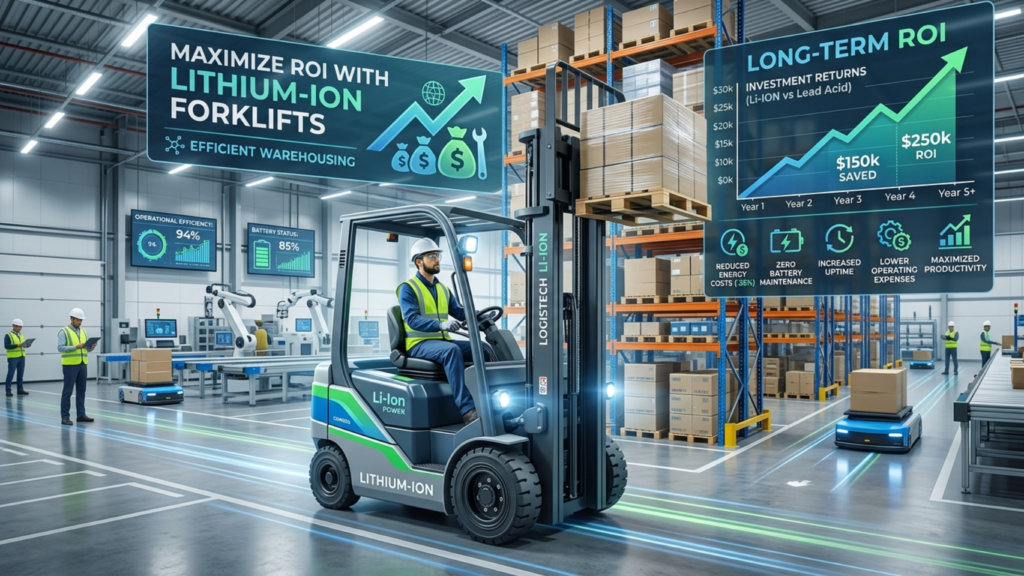
The Baseline: Lead-Acid Costs
For a two-shift operation, you need ten lead-acid batteries (two per truck). At five thousand dollars per battery, your initial cost is fifty thousand dollars.
Next, calculate the labor lost to daily battery swaps. Thirty minutes per day, per truck, equals two and a half hours of lost time daily across the fleet. Over a standard two-hundred-and-fifty-day work year, that equals six hundred and twenty-five hours of lost labor. At twenty-five dollars an hour, battery swapping costs your business over fifteen thousand dollars annually.
Finally, add maintenance time. Assuming one hour of maintenance per truck each week, you lose another two hundred and sixty hours annually. This adds six thousand five hundred dollars in yearly maintenance labor. Over five years, your labor and maintenance costs alone exceed one hundred thousand dollars.
The Upgrade: Lithium-Ion Costs and Savings
Now, let us run the same five-truck fleet using lithium-ion technology. You only need five batteries, as opportunity charging will sustain the trucks through both shifts. At fifteen thousand dollars per premium lithium-ion battery, your initial investment is seventy-five thousand dollars.
Your upfront equipment cost is twenty-five thousand dollars higher than the lead-acid baseline. However, your daily battery swapping costs drop to zero. Your weekly battery watering and maintenance costs also drop to zero. You completely eliminate the twenty-one thousand dollars in annual labor waste associated with lead-acid systems.
The Final ROI Calculation
In our example, the lithium-ion fleet costs twenty-five thousand dollars more upfront. Yet, it saves twenty-one thousand dollars in labor during the very first year.
By the second month of year two, the lithium-ion batteries have completely paid for their premium upfront cost. For the remaining three and a half years of our five-year projection, those labor savings go directly to your bottom line. Over five years, this simple five-truck fleet generates over eighty thousand dollars in pure profit simply by switching power sources. This calculation does not even include the thirty percent reduction in your monthly electricity bill.
Additional Financial Benefits to Consider
While labor and equipment costs form the core of your ROI calculator, lithium-ion technology provides several indirect financial benefits as well. Recognizing these broader advantages ensures your business captures every potential source of operational value and cost avoidance, further accelerating your return on investment.
Warehouse Space Optimization
Traditional lead-acid batteries require dedicated, heavily ventilated charging rooms. These rooms take up hundreds of square feet of valuable warehouse real estate. They also require specialized acid-spill containment stations and costly ventilation systems to manage dangerous off-gassing.
Because lithium-ion batteries are sealed and do not off-gas, you can place compact chargers anywhere in your facility. You can completely dismantle your old battery charging room. You can convert that reclaimed square footage into profitable storage space or additional packing lines. When you calculate the value of your facility by the square foot, reclaiming this space adds immediate financial value to your operation.
Reduced Utility Infrastructure Requirements
Unlike lead-acid systems that often necessitate extensive wiring, heavy-duty outlets, and centralized charging installations, lithium-ion chargers are generally lighter on infrastructure requirements. Many models can plug into standard industrial outlets, reducing installation costs, ongoing maintenance on high-amperage systems, and the need for specialized electricians—delivering both capital and operational savings.
Environmental Compliance and Sustainability
Lithium-ion batteries are more environmentally friendly, free from hazardous acid or heavy metal contamination. By reducing the risk of spills and hazardous waste, your facility can decrease environmental compliance expenses, simplify waste management, and more easily adhere to regulatory standards. Adopting advanced battery technology also supports your company’s sustainability initiatives, which may provide access to green business incentives, grants, or favorable financing rates.
Insurance Premium Discounts
Operational safety improvements, reduced risk of acid-related damage, and fewer heavy lifting tasks can contribute to lower insurance claims and potentially result in discounted premiums. Many insurers recognize the superior safety profile of lithium-ion systems and may adjust rates accordingly, helping you keep overhead expenses under firm control.
Improved Asset Utilization and Vehicle Life
Reliable, maintenance-free batteries mean forklifts spend more time in operation and less time sidelined for repairs, directly enhancing fleet utilization rates. Reduced vibration, consistent power output, and the absence of corrosive acid can also extend the overall life of ancillary equipment—decreasing long-term replacement costs for not only batteries but also the trucks themselves.
Enhanced Workforce Morale and Productivity
Operators working with lithium-ion technology benefit from user-friendly processes and safer work conditions. Minimizing the manual handling of batteries, exposure to caustic substances, and time-consuming maintenance directly raises satisfaction and efficiency. Reduced workplace injuries and improved morale translate to lower turnover, less absenteeism, and higher overall productivity.
Safety and Worker Compensation
Safety directly impacts profitability. Moving heavy lead-acid batteries with overhead hoists creates a significant risk for crush injuries. Exposure to sulfuric acid poses chemical burn and respiratory hazards. Workplace injuries lead to massive worker’s compensation claims, increased insurance premiums, and severe operational disruptions.
Lithium-ion batteries stay inside the forklift. Operators never handle heavy, hazardous power cells. By completely removing battery swapping from your daily workflow, you eliminate a major source of warehouse injuries. A safer workplace protects your employees and shields your company from expensive liabilities.
Warehouse Space Optimization
Traditional lead-acid batteries require dedicated, heavily ventilated charging rooms. These rooms take up hundreds of square feet of valuable warehouse real estate. They also require specialized acid-spill containment stations and costly ventilation systems to manage dangerous off-gassing.
Because lithium-ion batteries are sealed and do not off-gas, you can place compact chargers anywhere in your facility. You can completely dismantle your old battery charging room. You can convert that reclaimed square footage into profitable storage space or additional packing lines. When you calculate the value of your facility by the square foot, reclaiming this space adds immediate financial value to your operation.
Safety and Worker Compensation
Safety directly impacts profitability. Moving heavy lead-acid batteries with overhead hoists creates a significant risk for crush injuries. Exposure to sulfuric acid poses chemical burn and respiratory hazards. Workplace injuries lead to massive worker’s compensation claims, increased insurance premiums, and severe operational disruptions.
Lithium-ion batteries stay inside the forklift. Operators never handle heavy, hazardous power cells. By completely removing battery swapping from your daily workflow, you eliminate a major source of warehouse injuries. A safer workplace protects your employees and shields your company from expensive liabilities.
Take Control of Your Operational Costs
Switching to advanced material handling technology is a major decision that requires clear financial justification. By utilizing a comprehensive lithium-ion forklift ROI calculator, you remove the guesswork from your equipment upgrades.
When you look beyond the initial purchase price, the financial advantages of lithium-ion power are undeniable. You dramatically lower your daily labor costs, slash your energy bills, and create a safer, far more productive work environment. We encourage you to run the numbers using your own facility’s specific labor rates and shift schedules. You will likely discover that transitioning to lithium-ion technology is one of the most profitable investments your company can make.